

Notes to Poem IX
i. MS Text: The text of this poem begins at the foot of p. 133 of the MS; it occupies the whole of pp. 134-140, and concludes at the top of p. 212. The move from p. 140 of the MS to p. 212 indicates that the foliation of the MS was disturbed at some stage after the poem was placed in it. Fading and wear in the outer margins of MS pages occasionally affects the legibility of the text, but it is generally clear.
This is the longest ballad text in BDL, running to no less than 72 quatrains as presently edited. It is also the text which shows the most extensive emendation by the BDL scribes subsequent to the writing of the first draft, and there can be no doubt that they had access to one or more versions which differed noticeably from that provided by their original source.
ii. General background:
(1) Theme
The poem relates how Caoilte mac Ronáin was instrumental in liberating Fionn mac Cumhaill from his imprisonment in Tara by the legendary king Cormac mac Airt. The circumstances leading to Fionn’s imprisonment are outlined in the later version of Acallam na Senórach (AS2: ed. Ní Shéaghdha, pp. 67-83), which preserves a text of this poem. According to AS2, Donn son of Angus, who had formerly been king of two provinces of Munster, had been reduced to such an extent that he served as a member of Cormac mac Airt’s warband, where he came under the jurisdiction of Fionn mac Cumhaill. At the end of a year, Donn asked Fionn for payment in the form of the secret which Fionn was most loath to tell. He had been promised this if he gave his services to Fionn, and Fionn had to keep his word, however unwillingly.
The secret was a plot to overthrow Cormac, and when it was divulged to him, Donn promised not to tell the king. He did, however, warn him, and when Fionn put the plan into operation, he was promptly seized by Cormac. AS2 then provides a prose summary of subsequent events, and this is followed by the lay itself. The narrator throughout this section of AS2 is Caoilte himself, who responds to Patrick’s request to tell the story of his corr-imirce or “odd drove”, whose gathering is elaborated in the ballad.
The ballad narrates that, when Fionn was in prison, Caoilte did feats of mischief throughout Ireland (BDL qq. 1-10). Eventually he turned his attention directly to Tara. After causing some confusion among the married couples there (qq. 11-13, he tried to get past the king, first by posing as his door-keeper and narrowly escaping detection (qq. 15-17). He then proceeded to gather some of the moss of Seisgeann Uairbheoil, which he presented to Cormac, who perceived Caoilte’s smell from the moss (qq. 20-23). (AS2, in its prose summary, explains that it was a geis of the king of Tara to receive this moss.) His identity thus established, Caoilte asked Cormac whether there was any way in which he could obtain the release of Fionn. Cormac stated that the only condition on which this could be done was that Caoilte should collect a couple of all the wild animals in Ireland, and Caoilte agreed to this bargain (qq. 24-28). The ballad then describes Caoilte’s itinerary, providing a long catalogue of place-names and animals obtained at each place (qq. 29-52). Having gathered the animals, Caoilte had difficulty in keeping them together, the fox being particularly troublesome (qq. 53-58), but he managed to take them to Tara, where Cormac put further obstacles in his way (qq. 61-65). Nevertheless the task was completed successfully, and the animals scattered when Fionn was released. Caoilte then exults in his fleetness of foot which made the achievement possible (qq. 69-72). The overall structure of the ballad is loose and episodic, the adventures narrated before the gathering of the animals being difficult to relate to the plot as a whole.
(2) The antecedents of the ballad story
The most conspicuous part of the ballad is that which tells how Caoilte collected a couple of all the wild animals of Ireland. This motif is known internationally, and occurs at a much earlier period outside Ireland. The theme of gathering pairs of wild animals into a boat to preserve their seed from destruction by flood is known in Hebrew tradition, and is attested in the story of Noah in Genesis 7 and 8. It is found also in Babylonian, Hindu and Aztec contexts (Thompson, Motif Index, A 1021.1). In the ballad, however, the gathering of the animals is portrayed as an impossible task, rather than as an attempt to save species. The motif of the impossible task is also well known internationally; one version tells how a trickster is given one year in which to fulfil impossible bargains, failure leading either to his own death or that of the other person in the tale (ibid., M 291). Professor Gerard Murphy sees a further resemblance between the ballad theme and “the international folktale of the rabbit-herd, who with the help of his magic pipe, calls rabbits together, and thereby wins a princess as his bride” (DF, III, p. 19, n.2).
Murphy’s suggestion seems less appropriate than the other two parallels cited above, but it takes into account the purpose of the task of assembling the animals in its earliest known Irish version. This is found in a prose tale which Murphy would date to the tenth or eleventh century (ibid., pp. lix, 19). This tells how Gráinne, who is being wooed by Fionn, whom she hates, demands as her bridal gift that a couple of every wild animal should be brought to the rampart of Tara. The task is achieved by Cáilte coslúath. The animals are not enumerated in a catalogue, but there is mention of the difficulty which they gave the collector, with special reference to the fox. ‘“Cid as andsom leat tucais?” ar Cormac. “Ni ansa. Romgab do leith losinan” ar Cailti.’ (For text, see Meyer.)
The gathering of the wild animals as a bridal gift for Gráinne places the theme firmly in the context of the Fian, and also shows a close link with Tara. By the time Acallam na Senórach was compiled c. 1175, the story of the drove was connected with the freeing of Fionn from Cormac. A brief passage summarises the story of the ballad:
‘“…Ocus iss e sin darna la as mó fuaras d’ ulc riam,” ar Cailte, “in la sin ac fastod na Féinde 7 in la ro fuaslaices Find ó Chormac 7 tuccus in chorrimirchi dó.”‘ (Stokes, IT, IV, ll. 4976-8)
In a sequence of verses celebrating his own achievements elsewhere in the Acallam, Caoilte refers to his gathering of the animals:
‘Ro bo mhé in Cailte co cruth . sochaide dá tucus
uch,
dá ro tinóilius dom rith . lánamain gach fiadha ar
bith.’ (ibid., 3614-5)
These lines should be seen alongside others in the same text in which Caoilte boasts of his running ability, and of the mischief which he perpetrated when running:
‘“Ar fír do ghaile ocus do gaiscid, a rí Feinde,” ar Blathmec “indis duinn adbar do retha riu-sin, a Cailti.” Ocus atbert Cáilte:
An cetrith dorinnes díb . sochaidhi tuc a n-imsním
dar gabus, ba caem mo rith . lanamain gach fiadha ar
bith
In rith roba nesa dó . is ed a fir is ni gó
dar cuirisa [
] fa all . atha ocus muillidh Érenn.
“Ro ba mór an luth sin, a Cailti,” ar Blathmec. “Ropa mor,” ar Cailti, “uair on trath co chéili dorighniusa o Thuind Clidhna andes co Tuind Rudhraigi budtuaid.” Ocus atbert Cáilte:
Is é mo rith ‘sa tres ló . is ed a fír is ni gó
dar’ léigius láigh do buáib . a nÉrinn alaind
adfuair.’ (ibid., 7367-8)
Here we see Caoilte’s runs connected with specific places in Ireland, and there is also a close connection between two of the verses in this passage and qq. 6 and 9 in the BDL text.
The evidence of the earlier version of the Acallam would seem to indicate, therefore, that Caoilte’s exploits were a popular topic by the second half of the twelfth century, perhaps forming a sub-cycle in their own right. The story of the present ballad is clearly represented in both prose and verse. This lends support to Murphy’s view, based on a linguistic analysis of the DF version of the ballad, that the poem may date to the second half of the twelfth century (DF, III, 17-18). But it is not easy to determine how much of the poem as preserved in AS2 and BDL may have been known before 1200. There is evidence to suggest that the text of the poem may have been expanded in the course of the Early Modern period. Such development may be reflected in the fact that, while the earlier Acallam had a considerable interest in Caoilte and his feats, it preserves only a few verses commemorating his prowess; whereas AS2 preserves a text of the present ballad which is very close to that in BDL, particularly in its catalogue of animals and place-names, a feature which is not attested in the Acallam of c. 1175.
(3) Place-names
Although the earlier Acallam does not contain a catalogue of the places visited by Caoilte on his celebrated runs, it does attempt to name the two farthest points which he reached (“o Thuind Clidhna andes co Tuind Rudhraigi budtuaid”) and it might be argued that this could be the beginning of the elaboration found in the present poem. In addition, the Acallam and the ballad share a common interest in onomastics, which is likely to account for the inclusion of the poem in AS2. The Acallam itself is firmly within the tradition of dindshenchas, “the lore of famous places”, which tries to explain how particular places were given their names. This genre was cultivated long before the Acallam was compiled, and specimens in both prose and verse antedating the Acallam are well attested, possibly from as early as c. 950 (M. O Daly, ‘The Metrical Dindshenchas’, in Carney ed., E. Ir. Poetry, 59-72). As AS2 testifies, an interest in dindshenchas was maintained into the Early Modern period.
This can also be seen in bardic material, where specifically topographical poems have survived. These topographical poems are not concerned to explain the origins of place-names; rather, they enumerate the ruling families of the districts which they mention, and are no doubt intended as a roll-call of prominent patrons, as well as a display of onomastic knowledge (Carney, Topographical Poems).
The treatment of place-names in BDL IX likewise shows no interest in the background to the names it lists; they are simply the signposts on a journey. The concept of a journey round Ireland which has Tara as its starting-point, basic to BDL IX, can be paralleled readily in the topographical poem composed by Seaán Mór Ó Dubhagáin, which opens with the quatrains (ibid., 1):
Triallom
timcheall na Fódla,
gluaisid fir
le ar bhforfhógra,
as na fóidibh
i bhfuileam
na cóigidh go
ccuartuigheam.
Dénom ar tús
go Teamhraigh,
go faithche an
mhúir mhíndealbhaigh,
toisg gnáth ná
leagaid seach láimh,
teagaid cách i
n-ar ccomhdháil.
Ó Dubhagáin’s poem goes on to list places and families in the northern half of Ireland, and in Leinster. Ó hUidhrín, on the other hand, sets out to describe “the southern half, Munster, Leinster, and the lands about the lower Shannon” (ibid., vii-viii). Ó Dubhagáin died at Rinn Dúin, Co. Roscommon, in 1372, and Ó hUidhrín died in 1420 (ibid., viii).
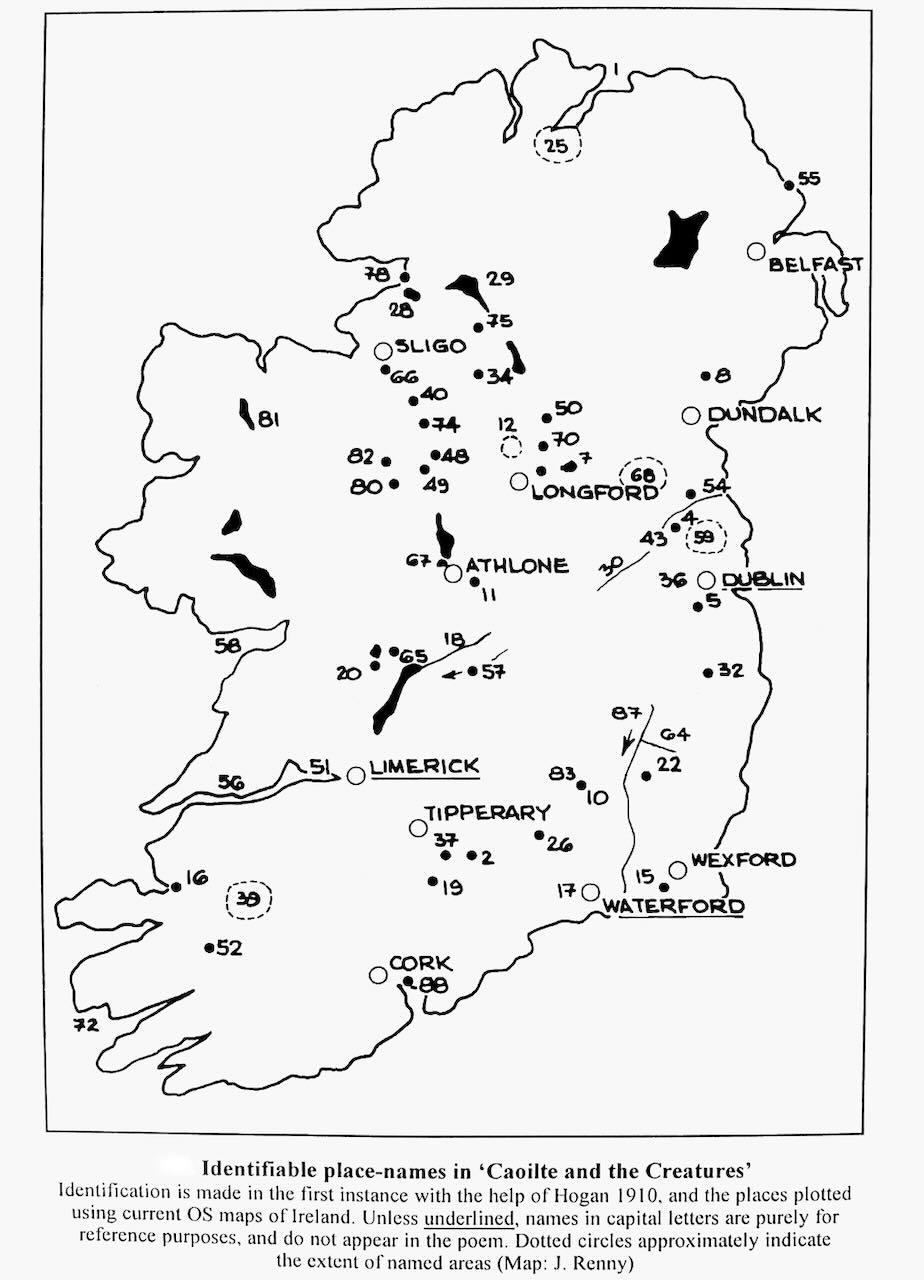
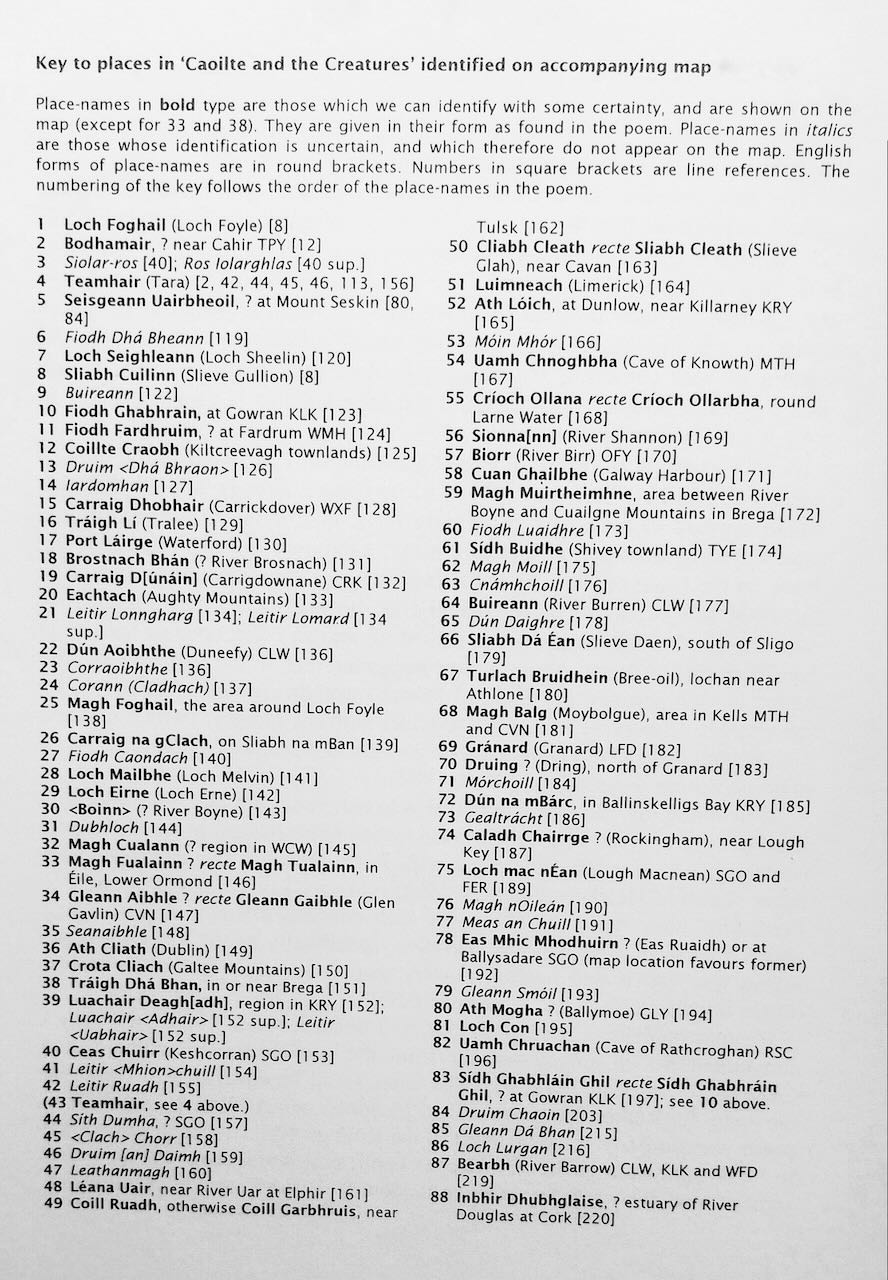
Given the wealth of existing onomastic works, there is an initial possibility that the catalogue in the present poem has utilised an earlier source (or several sources). As far as can be judged, however, this possibility can be laid aside. The catalogue would appear to be an independent piece. For this reason, it is worth trying to identify the places mentioned, and by plotting them on a map, to see whether any pattern emerges. A map and key are provided. Here we may draw the main conclusions together.
Of the 87 or so place-names furnished by the BDL text, just over 30 cannot be identified; of the remainder, the majority can be located tentatively on the map. With the unidentified names, the main difficulty is that the same place-name can be known in several different parts of the country; such names are immediately followed by a question mark in the key without any further comment. Where a question mark precedes an identification in the key, this means that there are some grounds for uncertainty, but that, on balance, the identification seems sound.
Given that more than a third of the place-names listed in the catalogue are not yet identified, any general conclusions must be treated with caution. However, the 50 or so remaining place-names do appear to provide a fairly consistent overall pattern. This shows a concentration of place-names to the south and south-east of Sligo, in Roscommon and Longford. Proceeding southwards and westwards, names continue as far as Limerick, and then seem to swing eastwards in an arc through Leinster and northwards towards Meath. Few place-names occur in Munster, east Connacht and Ulster; where they do occur in these areas, they tend to be fairly prominent places, such as Lough Foyle (13), Lough Con (81), and Galway Bay (58), although there are occasionally some apparently inconspicuous places, such as Shivey townland, Co. Tyrone (61). The counties of Offaly and Laois also seem to be relatively bare of place-names. The overall pattern, therefore, would appear to be that of an ellipse, with Sligo at its northern tip, and Waterford at its southern tip, with the bulk of place-names towards Sligo.
How is this pattern to be interpreted? It must be emphasised that the poem does not present the place-names in a geographically ordered sequence; Caoilte’s expedition appears erratic for the simple reason that the work is a poem, in which the demands of metre and rhyme are of primary importance. It is only when the names are plotted on a map that a pattern seems to emerge, for which the expedition provides merely a context.
The key to understanding the significance of the place-names in this ballad would appear to be provided by a consideration of the toponymic evidence afforded by other BDL ballads. When this evidence is examined, it will be seen to offer a pattern remarkably similar to that found in the present poem. The evidence of the other BDL ballads has been taken as bearing a relationship to their likely places of origin, and as reflecting those parts of Ireland with which BDL had closest links. A general similarity with the distribution pattern of bardic verse to Irish patrons in BDL is also apparent. All three bodies of evidence show a primary interest in the region to the south and east of Sligo. The present catalogue brings Leinster and Meath more clearly into focus.
Under such circumctances, therefore, it is clear that the place-names in BDL IX are only superficially concerned with the runs of Caoilte, and fall far short of an exhaustive coverage of Ireland. The poem is, to a large degree, a display of onomastic and lexical knowledge, which is inevitably dependent on the skills of (probably) several composers.
iii. Other versions: Outside BDL, this poem is found only in Irish tradltion. As has already been noted, it occurs in the later version of Acallam na Senórach. This version is thought to date from the fourteenth or fifteenth century, although the evidence for such a dating involves a fair amount of subjectivity. The earliest MS of AS2, RIA MS 24 P 5, belongs to the late seventeenth century. If the date ascribed to AS2 is correct, the version of the present poem associated with it could be earlier than that in BDL. RIA MS 23 L 22, which is an inferior copy of 24 P 5, has a text of this ballad, and so also does RIA MS F v 2. These texts clearly form a closely related group. Yet another version of the poem occurs as DF VII, and is thus a century later than BDL. We may examine the relationship between the BDL, AS2 and DF versions in terms of overall structure and line readings.
(1) Overall structure
A cursory glance over the three main versions of the ballad is enough to indicate that the BDL text is the longest (72 quatrains), while DF (at only 29 quatrains) is the shortest. AS2 preserves a text of 55 quatrains, and it obviously corresponds more closely to BDL than does DF. Not only has DF apparently lost a considerable number of quatrains, but the sequence of the remaining quatrains shows confusion and dislocation of the story-line. In AS2, the order of the quatrains is generally similar to that in BDL. The structural relationship between the versions will become clearer if we consider the quatrains which are common to, or distinctive of, the texts concerned.
(a) Quatrains common to BDL and AS2 but not in DF: The closer relationship of BDL to AS2 is apparent in the catalogue of animals and place-names, which amounts to 23 quatrains in BDL (qq. 30-52). Of these quatrains, 19 are found in AS2, but only 4 in DF. The apparent loss of quatrains in DF reflects the vulnerability of catalogues in transmission, since they can be reduced (or expanded) without harming the story-line of a poem. Given that the DF version attests such a sharp reduction in an Irish context, where the place-names might have been expected to retain their relevance, the fine state of the BDL catalogue (admittedly a century older than DF) is all the more striking, particularly if AS2 is earlier than BDL. AS2 may well have begun to lose quatrains from the catalogue, a possibility increased by the discrepancy in the actual ordering of the couplets in the quatrains common to BDL and AS2.
BDL and AS2 again tend to correspond fairly closely, although not precisely, in the quatrains describing Caoilte’s adventures before goinq to Tara (BDL qq. 4-10), and his tricks on arrival (BDL qq. 11-29). DF has consistently less quatrains in these sections than AS2, although it includes versions of BDL qq. 5 and 9, both of which are unattested in AS2. The concluding quatrains of the BDL version (qq. 67-72) are found, with one exception (q. 71), in AS2, but they do not occur in DF which has a quatrain of its own.
(b) Quatrains peculiar to BDL: The BDL version of the catalogue includes 4 quatrains (qq. 46, 47, 48, and 52) which are not found in the other two texts. Qq. 46-48 are within the main body of the catalogue, and they contain Irish place-names, which suggests that the quatrains may not be independent Scottish developments. On the other hand, it is conceivable that these quatrains are accretions to the poem which took place only in the textual tradition represented by BDL; but given the close relationship between BDL and AS2 in other aspects of the catalogue, it is possible that they have simply been lost from AS2. Q. 52 rounds off Caoilte’s collecting trip, but there is no evidence to indicate whether or not it is a later addition to the text.
The most obvious difference between BDL and the other texts lies in BDL qq. 60-66, which describe how Caoilte took the animals to Tara, but had to lodge them in two houses which had been specially designed by Cormac to cause maximum difficulty. The first of these houses had nine open doors to encourage the creatures to flee (qq. 62-63), while the second had fifty doors, all of which were closed, with the animals inside and Caoilte outside (qq. 64-65). The descriptions of the two houses seem suspiciously like variants of one another; the boast by Caoilte in q. 66 (l. 263) that he did not let a single animal out could suggest that the description of the house with the open doors is the earlier of the two. As to whether the theme of “the house and doors” was elaborated in an Irish or Scottish context, the slender linguistic evidence of l. 256 would suggest Ireland rather than Scotland. Whenever this elaboration took place, the extensive emendation of qq. 65-6 by the BDL scribes indicates that the sequence was well established in the textual tradition which was available to them, although it does not appear in either AS2 or DF.
Other quatrains distinctive of the BDL text are: q. 4, heading up the verses describing Caoilte’s mischief before going to Tara; q. 23, in which Cormac indicates that he has identified Caoilte; qq. 27-29, telling how Caoilte clinched the bargain with Cormac, and set out from Tara; q. 58, relating the antics of the fox; and q. 71, in which Caoilte boasts of his great leaps. Of these, qq. 4, 23, 27, and 29 were emended by the BDL scribes, and they would therefore appear to have been known in more than one version of the poem.
(c) Quatrains peculiar to AS2: Only one couplet and two whole quatrains (AS2 qq. 4 ab, 23 and 25) are attested solely in AS2. The significance of q. 4 ab is discussed further below. Q. 23 records Caoilte’s response to Cormac mac Airt’s statement that there is only one condition on which he will free Fionn; q. 25 relates how Caoilte went to collect the animals and later brought them to Tara. In terms of BDL, AS2 q. 23 would follow BDL q. 25, and AS2 q. 25 would follow BDL q. 26; in fact, AS2 q. 25 seems to correspond in general thought to BDL q. 27-29, discussed in the preceding section.
(d) Quatrains peculiar to DF: DF contains 4 quatrains which are not in BDL or AS2, namely DF qq. 20, 22, 23, and 29. Q. 20 occurs in the catalogue of animals and place-names, and it follows the pattern of the verses in the other two versions, with characteristically Irish locations. The existence of this quatrain in DF alone strengthens the possibility that the catalogue may have experienced some piece-meal development at different times, perhaps in different parts of Ireland. Qq. 22-23 relate in general terms the difficulty which Caoilte experienced because of the scattering of the animals. They contain echoes of BDL qq. 61-62, and they could be later recastings of the verses represented in BDL. Q. 29 is the final quatrain in DF, and it would appear to have been inserted to provide an appropriate dúnadh for the poem corresponding to the opening words of the DF version, “Maidhim in mhaidin fa ghlonn”. Q. 1 of the DF text corresponds, in fact, to q. 2 in BDL and AS2. It is noteworthy also that DF q. 29 presents the speaker as a sad old man, lamenting the loss of his friends. This suggests that he has been confused with Oisean.
(e) Quatrains relatinq to Cuirreach Life and Bodhamair: All three texts contain quatrains which refer to the killing of a warrior whose head is then carried off. BDL and DF each have one quatrain relating to this incident (BDL q. 3, DF q. 2), while AS2 has two quatrains (qq. 3-4). The quatrains in AS2 are worth quoting in full (AS2, III, p. 73):
Do chearbsamar laoch fā líach
an uair do chearb-samh ar ttriath,
7 tuccsam cath iar soin
ait a ttorchoir ceann Curraigh.
Cuirreach Life cona lí
ro chuirseam é ar neimhthní,
7 ruccsam a cheann gan choir
ar an árd ōs Bhodhamair.
The quatrain in DF is a variant of the first of these quatrains in AS2, but the quatrain in BDL contains variants of the first couplet in AS2 q. 3 and the second couplet of AS2 q. 4, perhaps suggesting that the BDL quatrain reflects an error in the transmission of the text, conceivably at the scribal level.
It is difficult to see how the story of Cuirreach Life relates to the ballad as a whole. Indeed, it seems likely that it has been brought into the text partly on the strength of its dindshenchas associations, which are compatible with the onomastic interest of the ballad. A version of AS2 q. 4 appears in the First Recension of the Metrical Dindshenchas which may have been compiled in the period 1100-1125, where it has the following form (Gwynn, Todd Lect. Series, XII, 113, 235):
Currech Life cona líis terc rí dia rodamain:
rucad a chend úad i cían
cosin slíab os Bodamair.
Here it occurs as the first of six quatrains on the death of Cuirreach Life. The circumstances of his death are described in the eleventh-century prose tale Bruiden Atha (Meyer, ‘Bruiden Atha’, 242-5). It would appear from this that Fionn had found a paramour, Badammair, in the area of the Suir. Cuirreach Life had killed Badammair’s foster-brother, and when Fionn went to seize Cuirreach, he cut off Badammair’s head. Fionn pursued him and decapitated him. The tale includes a variant of this quatrain. As the compiler of Bruiden Atha points out, the story explains the place-name Cenn Currigh, “the Head of the Curragh”, considered to be on the south side of the Suir in Co. Waterford (Gwynn, Todd Lect. Series, X, 519). We may also note the correspondence between Badammair’s name and the place-name Bodhamair, which is perhaps to be located near Cahir, Co. Tipperary (Onom. Gad. s.v. badamair).
The story of Cenn Currigh was known to the compiler of Acallam na Senórach. The Acallam states that Fionn struck only the first blow, and that Oisean decapitated Cuirreach. Thereafter Caoilte buried him, and carried his head to Bodhamair. This is commemorated by a quatrain (Stokes, IT, IV, ll. 7914-24):
Rucas liom an
cenn iarsain
cusin cnuc os
Bodhamair,
co bfil ann
ósin ille
isin chnuc ‘na
chomnaide.
The episode is also related in AS2, attributing the slaying to Fionn rather than Oisean, but maintaining Caoilte’s role in carrying the head (AS2, II, 43. 45, 53). It therefore seems likely that another reason for the inclusion of a reference to Cuirreach Life in the present ballad was Caoilte’s feat in carrying his head, since the ballad celebrates Caoilte’s exploits.
(2) Line readings
A distinctive feature of the BDL text of this poem is the extent to which it has been emended by the scribes subsequent to the writing of the first MS draft. Given such full evidence of emendation, and the existence of an Irish version apparently written earlier than BDL (i.e. AS2), as well as an Irish text later than BDL (i.e. DF), it is worth enquiring whether the superscripts in BDL take the text closer to, or further from, the Irish versions. The pattern may be outlined as follows.
(a) Instances where the original BDL reading is close to AS2 but where the superscript differs: 11, 24, 31, 42, 59, 88, 134, 148, 152, 153, 157, 160, 161, 162, 165, 167, 212, 224, 225-6, 227-8, 286, 288.
(b) Instances where the original BDL reading differs from AS2, but where the superscript is closer to AS2: 11, 43, 56, 94, 95-96, 175, 223, 234.
(c) Instances where the original BDL reading is close to DF, but where the superscript differs: 78, 123, 136, 220.
It is clear from this pattern that, as (a) and (c) show, the overall tendency is for the BDL superscript readings to be distinct from the readings of the Irish versions, where these agree with the first BDL draft. The BDL superscripts thus represent a drift away from the Irish versions. Nevertheless, (b) indicates that the original BDL draft is already distinct from AS2 in certain readings, but that these readings were later altered to a form nearer AS2. This latter point reflects the complex relationship between the different versions of the poem available to the scribes, even though these versions probably belonged to the same family. With regard to DF, it must be remembered that this version is too short to give a detailed picture of its relationship to the different textual levels in BDL. It is to be noted, however, that in the formula employed in BDL qq. 4-9, BDL is closer to DF than to AS2.
iv. Metre: Deibhidhe
v. Line annotation
3 go <h-airm an >: Go horm<ȳ> (meme) moyr MS. It is by no means clear what the scribe intended to convey by meme, which he later cancelled; the superscript moyr could represent mór or muar, but the significance of the reading is obscure. HP follows AS2 in restoring the line as go h-airm i mbaoi an bhorrshlat mhir.
mhórshlat: As indicated in the preceding note, HP restores the MS form morlat as bhorrshlat. While borr, “big, large, mighty” (RIA Dict. s.v.) may well be the first element, it may also be mór, as the MS spelling itself might suggest.
6 < >: The scribe originally wrote gvs , evidently representing gus, which is hard to construe syntactically; this was deleted, and what is evidently yrs written in superscript. If we allow the g- of the first reading to stand, and bring forward the initial of the following word in the MS, namely a-, we arrive at gyrsa, which may take us towards gearsom the reading in AS2. The AS2 reading is to be understood as gé + 1 sg. ro-pret. of the copula, and makes sense syntactically. It might be legitimate to restore gearsom here, assuming that the BDL scribe was groping towards this form. It is possible that his attempts reflect misunderstanding of contractions in his exemplar. One gets the impression here and in 3 n of a rather blind approach by the scribe, perhaps puzzled by the meaning of lines.
fuileach: On the possible significance of a- in the MS form af<wu>llyt, see the preceding note. The occurrence of w and u together in the MS representing /u/ is unusual.
7 folmhuighdís: The restoration follows the original MS form folwothdeis which the scribe later deleted in favour of wuldeis. The significance of the superscript is not clear; it may represent a syncopated form of the original reading. In the context of the quatrain, the line as presently restored would seem to mean that Caoilte did not exult “until fian-bands emptied (i.e. drew, or let) blood” above Loch Foyle. There may be an obscure reference in the quatrain to a now unknown story or custom. dār thraoitheasa Fíana i bhfuil (AS2); ros fothracdaois fiana a ffuil (DF).
8 The line lacks a syllable as it stands. The original poem may have read ōs bhordaibh; but cf. os úr Locha Feadhamhuil (AS2).
9-12 On the significance of this quatrain, see Section iii (1) (e) above.
9-10 Preceding this couplet at the top of MS p. 134, there is a line which HP has construed as the first couplet of a quatrain that was not completed. The position of the MS line and its resemblance to the present couplet make it improbable that it is the beginning of an incomplete quatrain. Rather, it would appear to be a variant of, or a gloss on, the present lines. The possibility that it is a gloss is suggested by the non-cancellation of these lines, Whatever its status, it seems to offer an alternative to 9-10; it reads warwemir i’ leit lay mir a warvemir in traye, which represents mharbhamar an laoch liath mar a mharbhamar an triath, “we killed the grey warrior where we killed the lord”.
9 Do chearmasdar: The verb seems to derive from cermnaid “lops, trims” (RIA Dict. s.v. 1 cermnaid), with a 3 sg. pret. deponent ending; cf. mar a chear[m]s[a]mar in 10. Do chearbsamar (AS2); Ro cherbhus (DF).
<fá liach>: fane lay MS. It is difficult to know how this phrase is to be understood. HP, following AS2, restores to fá liach, which is translated “whose death is lamented”. But cf. the MS form lay evidently representing liath in the alternative form of this line discussed above in 9-10 n. Nevertheless, the HP reading gives good sense, and is adopted tentatively here. With MS fane for fá, cf. V, 27 n.
11 rugs[a]mar: Without cancelling the original reading, the scribe wrote hugsmir (representing thugs[a]mar) in superscript. 7 ruccsam (AS2).
<as cain>: The restoration attempts to follow the scribe’s original reading <o>s ch<o>n, but not with much confidence. On cain, an adj. similar in meaning to caoin, “fine, beautiful”, see RIA Dict. s.v. 1 cain. The phrase might mean “which is beautiful”. Having cancelled the first reading, the scribe wrote gin cherri, that is gan chair, “without fault”, in superscript, whence the reading in HP. gan choir (AS2).
12 Bodhamair: The MS represents two attempts at spelling this word. On the second attempt, the scribe was uncertain whether the initial should be lenited, but opted for the unlenited form; thus MS <w>boyamir. The initial is lenited in AS2.
13 Do-rinn mi sin: This follows the scribe’s original reading Di royn missin. MS Di was later allowed to stand, but the remainder of the reading was cancelled in favour of the superscript ry’nis feyn#, the emended reading gives do-rinneas féin.
beodha[cht]: The MS form boya does not represent the final consonant group of the restored form; similarly in 17, 21, 25,29, 33. Cf. MS gi for gach in 16 and 20, and commonly throughout the MS.
24 uile: This follows the original MS reading wlli, later cancelled. The superscript doy<li>is might represent doilgheas, “sorrow, affliction”, or dólas, with similar meaning. uile (AS2, DF).
28 <a d’>fhos[g]lainn: a doslin MS. The original verb form must have been do fhosglainn as restored in HP: do fhosccloinn (AS2). Cf. MS a dowr<i> and a deaffryt for do fheóraich and do fhiafruigh respectively in 94. With the creation of the contracted forms d’fhosglainn, d’fheóraich etc., “relative” a may have been felt necessary to make up syllabic count.
31 ōn fhoghail: The scribe originally wrote one nowyl, later deleted in favour of vm ha<w>on, the superscript representing um Shamhuin, “at Hallowtide”, whence HP. im fhocchail (AS2).
38 The line lacks a syllable as it stands, and HP reads agus for is.
40 siar <Siolar-ros>: Thus the original MS reading schear sillar<a>s; the superscript ros IllirZlas represents Ros Iolarghlas. no go ránccos Iorrois (AS2); no go ranac go hAirgedros (DF).
41 <do leanas-sa siar>: This seems the only reasonable way of understanding the original MS reading a le<n>s a har; the superscript represents gluaisim-se siar, which loses a syllable in the line, and evidently prompts HP’s emendation following AS2, the latter having Iar soin iontaigheam iníar.
42 Thus, evidently, the original MS reading; the superscript represents go Teamhraigh nío[r]bh eidirchian. The most significant difference between the two readings lies in the prep. o (o MS) in the former, and go (gow MS) in the latter, the one indicating that Caoilte raced from Tara, and the other that he raced to Tara. As the preceding verses would seem to imply, Caoilte had not yet reached Tara, and the superscript might therefore seem preferable; however, the original reading could mean that immediately Caoilte reached Tara, he raced the horses away from the fort, and presumably back again (44). It is interesting that the BDL scribe has not cancelled the original reading in spite of the superscript, perhaps having concluded that either reading was valid! go Teamhraigh, gēarbh eidirchían (AS2).
43 <leigeadh>: Thus, possibly, the original MS reading leig<o>w; the superscript hairrin could represent théarainn, “got away, escaped” (see RIA Dict. s.v. do-érni), The precise significance of this line and of 44 is not clear; the general idea would seem to be that none of the horses was able to beat Caoilte to Tara. níor toirneadh (AS2).
47 <uaidh>: The MS form here could be read as uaċ or naċ. Orthographically the latter seems more likely, but the interpretation of MS naċ is not clear; HP takes it as the asseverative particle ana (RIA Dict. s.v. ane), which might be possible. Another solution might be that the form represents the 3 sg. m. prep. pron. restored in the present text. This may have been inserted in the line in an attempt to clarify the roles of the fir chomhtha mentioned in the quatrain. This process of clarification (leading to the breakdown of the rhyme scheme) seems to be attested in 4, where eile looks like an addition of this sort. In the quatrain as a whole rhymes are unsatisfactory; cf. the versions of this quatrain in AS2 and DF:
Tuccas i
tTeamhraigh immalle
bean fir
chomhtha dā chéle:
bean in fhir
comhtha sa
tuccas don
fhior comhtha sa. (AS2)
Go radus i tTemhraidh te
ben cumtha día
chéile
ben an fhir
cumtha-sa tra
uaim gus in
fir leptha-sa. (DF)
50 The line lacks a syllable as it stands, and HP, following AS2, inserts the prep. ó before Chairbre.
51-52 Both lines lack a syllable, and end-rhyme is unsatisfactory. The correction is not obvious in either case.
54 aithiseadh: Thus the original MS reading atissa. The significance of the superscripts wch and hay is not immediately clear; their positions on either side of fa suggest that they are to be regarded as two separate words, but this may not be so. HP construes the line as uch fá h-é [budh] mór a bhríogh, “ah! great was its power”. The original reading is much more easily accommodated – “a reproach which was of great substance/power”. gearbh eisiomh fa borb a bhrígh (AS2); um truaill féin ger mhór in gnímh (DF).
55 ghoil: Thus the original reading; the superscript gu<tt>i is probably to be taken as g[h]aid as in HP; fāth gan cheilt (AS2); Gile an ailt (DF)
56 chuirr: Thus the original reading; transl. “pointed” (< adj. corr). The superscript gives chuilg gen. sg. of colg “blade”; chuilcc (AS2).
59 anns an oidhch[e] thall: Thus the original reading; the superscript gives an adhaigh sin domh. isin oidhche thall (HS2); agus an oidhche sin (DF).
60 fā: The superscript represents bu; the following initial may have been dotted (to indicate lenition) when the superscript was inserted, since fā is normally non-leniting, but this is not certain.
64 am: HP takes MS y’ as representing an, and inserts the prep. ag; but this seems unlikely.
choinnleóir: The MS form kyllnor contains metathesis.
68 mhui[n]tir: The MS form wutir omits -n-, perhaps because the scribe had already written -u- which is orthographically identical in form with -n-.
70 This follows the original MS reading, but it is difficult to be sure how MS ga orreilteic is to be interpreted; the significance of the entire line is also in doubt. As restored, the line would seem to mean ‘“where I am at his great joy” – but to whom does his refer? Could the reference be to Caoilte’s light-hearted antics? If so, Fionn might be saying in effect, “He does not do that when I witness his exuberant tricks”. The superscript gives far a bhfeil e an bhforfhaoilte, “where he is in great joy”; this evidently refers directly to Caoilte, and it may perhaps signify “when he is at the height of his exuberance”. The later versions offer readings different from either of those in BDL: ol Fionn in chomhrāidh chaoin-te (AS2); sech gach fer dot locht laoídhthe (DF).
71 chan fhursann é: The influence of vernacular Sc. G. is apparent in this phrase, and HP emends to ní fhursannfadh; ní adhainfeadh (AS2). The scribe originally omitted the pron.; he then inserted it wrongly after MS connil, cancelled his error, and re-located it correctly (in superscript). This could suggest that the scribe was responsible for the Sc. G. features of the phrase.
chain: The third letter of the MS form ch<y>nni appears to have been e originally. The scribe may have been thinking of the form chaoin, but this is inappropriate metrically: on cain, see 11 n. coindil ccain (AS2, and similarly DF).
73 The line lacks a syllable as it stands; so also does AS2, which has Íar suin tāirrnic in t-ól; Anúair fa ttairnic in t-ól (DF).
74 HP modifies the line following AS2, ‘gon rí ro-ghasda ro-mhór; but cf. ag an rígh rogharg rómhór (DF).
75 <ceithr[e]>: The scribe originally wrote gar, which was cancelled, and the numeral iiii written in superscript. As a representation of ceithre, MS gar is not entirely convincing, and may suggest that the scribe intially misunderstood the form in his exemplar; it is also usual for numerals to be represented in the MS by their Roman forms, although this is not invariable. gérbh ē an coisgēim budh crúaidh sin (AS2); teigim leis nochar chéim cam (DF).
an gceann na gceann: in genn ni genn MS. To restore correct line length, HP emends to ceann i gceann, which is the usual form of the idiom, meaning “successively” (RIA Dict. s.v. cenn 53-56).
76 ’na theach: Thus the original reading; the superscript comprises two attempts at representing is taigh, as in HP. tēighim leis isin bhfíaltigh (AS2); co rainic in teg coitcionn (DF).
77 The line lacks a syllable as it stands, and HP reads do-chuadhas.
78 This follows the original MS reading, mir a balwm maylas; the 3 sg. m. poss. pron. is inserted on the assumption that initial m in MS maylas has heen projected from the preceding word, thus giving the meaning “when I wished to do him mischief”, i.e. to Cormac. The restoration m’aimhleas might nevertheless be possible, if the line could signify “when I wished to do my tricks”; but aimhleas normally means “mischief” in the sense of “disadvantage, harm”. The former interpretation (with a) is strengthened by DF mór dob áil liom a aimhleas; tan ba hāil dūinn aimhleas (AS2). The superscript alters all except MS maylas, and with it the line reads do bu bhlagh é do m’aimhleas, perhaps meaning “it was a part (? episode) which was to my disadvantage” (i.e. since it led to Caoilte’s being identified). HP, however, translates this form of the line as “it was a part of my mischief”.
80 cóinneach [Sh]eisginn: A superscript contains a second attempt at representing this phrase, without any significant difference from the first attempt.
81 fā-dear: Thus the original reading; the line appears to mean “Strange in my opinion is the thing which causes it” (see RIA Dict. s.v. fo-fera I (c), II (a). The superscript gives ris a bean, “which I touch”, as in HP. a ttucais damh (AS2).
82 fírgheal: Thus the original reading; the alternative evidently represents fíorghlan, as in HP. The latter gives less satisfactory rhyme.
84 air chóinneach: The superscript gives do chóinnea[ch]; thus HP.
87 adeire: (f)a derri MS. The form adeire makes the line hypermetric, and HP reads deire. It is possible that a in the MS has come about by accident, perhaps by incomplete cancellation of erroneous fa. rod-mher (AS2).
88 Thus the original reading; the superscript gives cuir-se th’úidh air oirfide; cuibhdhe d’aird-rí airfideadh (AS2).
89-90 Fā láimh…mar bhfuil: Thus the original MS readings; the sense of the couplet would seem to be “[Here] in subjection...where Fionn...is”. MS fa was later altered to Er, and MS vil to wee, giving the phrases the form Air [do] láimh…mur[a] bheith; the article before flaithfhéinnidh was probably deleted at the same time. The couplet as altered would then mean “By [your] hand...were it not for Fionn...”
91 ní thiurfainn: ne hurfin MS.
93 m’aithneamhain: Thus the original MS form ma’nwyn; nwyn was cancelled and neach written in superscript, thus representing m’aithneach[adh], the vernacular Sc. G. form. With the original form, cf. Mod. Ir. aithneamhaint (Dinn. s.v.). HP emends to Arnam aithne, following AS2.
94 Thus the original reading; the superscript gives a d’fhiafruigh mis[e] dho Chormac, which is hypermetric if -e of mise is restored (and requiring the removal of a at the beginning of the line: cf. 28 n). adubhart-sa re Corbmac (AS2).
95-96 This couplet is substantially altered in superscript, and in its emended form reads:
“An gabhadh tu cumh[a] ghlé
bhuam [a] dh’fhosgladh m’oide?”
As with 94 n, the emended form is closer to AS2 than the original; AS2 has ‘an ttabhraidh-si comhall nglé / damh re fuasccladh m’oide?’; note that AS2 likewise lacks a syllable in the second line. an innise dhamhsa dhe / créd d’ fúaisgeoladh am oide (DF).
The original MS reading for this couplet is difficult to construe, and 96 seems particularly opaque; MS voyt suggests bhuat, while gin vaddin looks like gan mhadain, but these possible restorations cannot be related easily to the rest of the line or to the preceding line. Scribal miscomprehension seems evident.
100 mar nach: Thus the original reading; the superscript reads da bi evidently for da budh, which HP emends to dámadh; da nach tualoing a faghail (AS2).
101-104 This follows the original MS form of the lines; the superscripts give a variant form of the quatrain which reads:
Dā bhfaghta tú dhomh rē lá
lamhnain bheó do gach fiadhán,
do gheobhadh tú th’oid[e] air
go ceart cumha [a] c[h]unbháil.
With the exception of 102, this is the version of the quatrain in HP; the version in AS2 shares features of both BDL types in its first three lines, but its last line is very different: go madh cuibhdhe ar ccomhmaoíne. Particular points in both BDL versions will be discussed in the following line notes.
102 lamhnain: The MS form lawnu’ appears to represent a variant form of lánamhain, “married couple”, here applied to animal pairs. The variant attests metathesis and syncope. The same form is represented by MS lawnon# in the superscript. In both instances, the trisyllabic form would make the lines hypermetric.
fiadhamhna: feyȝawnyt MS. This is a gen. sg. form of fiadhmhain, defined in RIA Dict. s.v. fíamuin as “some kind of swift-footed animal”. The superscript has fiadhán, which can signify “game, prey” (RIA Dict. s.v. fíadan).
107-8 This follows the original MS form of the lines; the superscripts give a variant form of the couplet which reads:
gun lēig<eadh> go réidh an rígh
dā bhfaghadh é
na fiadhmhíl.
HP follows the superscript version.
107 <dha rígheacht>: This restoration of MS ra reow is tentative; MS ra may attest the confusion of r- and ȝ- which sometimes occurs in BDL.
108 fiadhmhíola: The second element of this compound, namely míol, can havs a pl. míola or míl (RIA Dict. s.v. 1 míol, and Dinn. s.v. míol). The superscript fiadhmhíl has the latter form. The word fiadhmhíol is here used of a wild animal, not particularly a deer (cf. RIA Dict. s.v. 2 fíad).
111 an dtiomsugh<[adh]>: The normal form of this vb. n. is tiomsughadh (RIA Dict. s.v. timsugad), but the MS form deymsow attests apocope; cf. MS hymsow in 115. Here, however, the insertion of the final syllable makes the line hypermetric.
dhomh: The MS form royve attests r- rather than Z- under the influence of the preceding final consonant. Cf. XII, 50 n.
112 an dtioms<ughadh>: Trimming has removed the last few letters of the MS form, but the restoration is hardly in doubt; cf. 111 n.
113-4 This follows the original MS form of the couplet; superscripts give a variant form of the couplet which reads:
Gluaisim turus ō Theamhraigh
fā turus fir go meanmain.
HP follows the superscript version.
113 Gluaisim: In the MS form, -im is represented by three minims, the first being dotted.
<thoir>: This seems the best way of understanding MS er, although the map indicates that Caoilte’s efforts were concentrated west of Tara. The superscript has no directional reference.
114 nochar <thriall>: nochar reyll MS. If the restoration of MS reyll is correct (as turus in the superscript would suggest), the line means “it was not the journey /expedition of a man without courage”. The superscript seems to make the same point positively: “it was the journey of a man with courage”.
gan mheanmain: The original reading is not in doubt; the superscript form ma’nee in the corresponding phrase does, however, seem strange at first sight, but probably represents a dialectal variant such as meamna with metathesis (for declensional forms and meanings, see RIA Dict. s.v. menma).
117 ii gheilt : Here, as generally throughout the catalogue, the scribe uses the Roman form of the numeral two. In the edition this practice is allowed to stand, since it avoids the difficulty of knowing whether the f. form dí should be used with f. nouns in the dual. HP systematically reproduces dí on such occasions (as here), but the evidence elsewhere would suggest that the scribe would use dá with f. nouns, as in Mod. Ir. and Sc. G.; thus MS da hwle representing dá shúil in 64.
119 For the possible identification and location of place-names in the catalogue and throughout this poem, reference should be made to the map and key accompanying Section ii (3) above.
121 ii shionnach: The scribe omitted the numeral when beginning this line, and corrected himself in the superscript, evidently inserted just after he had reached Sléibhe.
123 <a Fiodh>: In the MS, these elements seem to be tacked on to the preceding word, giving Zessivey.
Ghuirm: Thus the original reading; the superscript gives Dhuinn, as in HP. Fiodh Ghaphra guirm <DF); Fiodh Gabhráin Guill (AS2).
126 Dhrom[a] <Dhá Bhraon>: Zrom Za wrein MS. do leathtaoíbh Dhroma Dha Ráon (DF).
127 Thus the original form of the line; initial is was subsequently cancelled, as was MS ear don, with a superscript added representing o shoin amach, as in HP. is da dhobhrán iar soin (AS2); agus dá dhobhrán iar soin (DF).
128 ō Charaidh: It seems likely that the element represented by MS charri derives from cora or cara, “weir” (RIA Dict. s.v. cora); cf. o Choraidh (DF); but a Charroic (AS2).
dhonnbháin Dhobhair: The initials of both elements in the MS show ȝ- written over d- or possibly vice versa. One would expect lenited initials. dhonnbháin Dobhair (DF, and similarly AS2).
131 iiii: This numeral breaks the sequence of pairs, and may have come about originally by accidental repetition of ii; however, this possible error goes back to the common source of BDL and AS2, since AS2 reads ceithre snoicc. It is also worth noting that to read dá snag loses a syllable in the line.
<sneachta>: The MS form snekga may represent a variant of snag, pl. snaig or snaga. The word can designate a snail, creeping thing, a type of small fish, shore bird (unidentified), woodpecker or magpie (Dinn., s.v.).
ōn: The scribe accidentally omitted this word, and jumped forward, writing brost, which he immediately cancelled.
132 D[únáin]: Only the initial can be read in the MS; the rest of the word is supplied from AS2.
134 Lonnghairg: Thus the original reading; the superscript, although smudged, appears to represent Lomaird, as in HP. Leitre Lonn-gharcc (AS2); as Leitir Lonnghairg (DF).
135 ō: The scribe originally wrote a, but this was cancelled and o put in superscript.
137 <c[h]ladhaig>: At first sight the MS form cleyt might appear to represent some such word as cliath, but this is metrically impossible, and AS2 in Choruinn chladhaigh is followed.
138 <shár-fhiach>: This restoration of MS harr[e]ich is very tentative; dhā eirrfhiach (AS2).
140 <Feadha> Caondaich: The first element here reproduced occurs as superscript faa. This replaces hy, which could possibly represent Thighe Fheadha Caonnach (AS2).
141 pheasān: Thus the original reading; the superscript represents pheas, which loses a syllable in the line. Dá pheasan (AS2).
143 <ón Bhoinn amach>: The scribe originally wrote one wownit mach; the first two elements were then cancelled, and mown<t> written in superscript, this was deleted, and a further superscript added, this time on vownyt a. The significance of this sequence may be no more than orthograpic; but the second superscript may represent Mónadh, with the scribe thinking in terms of Mónadh Mach[a] or some such name. The third superscript is very close to the original reading, with the a evidently meant to link up with the following mach; cf. Mónadh Mafa (AS2).
144 <ghairgēan>: Zergin MS. The line lacks a syllable as it stands, and HP emends to dí ghairg dhiana, following AS2.
145 Moighe Cualann: The scribe omitted Moighe originally, and this was inserted in superscript; this was followed by a second attempt at spelling Cualann.
147 Gleann <Aibhle>: The second element of the MS form glenn awlle could represent Abhla. a Ghleann Gaibhle (AS2).
148 ghealbhann: Thus the original reading Zalwon#; the last three letters of this form were later cancelled, and lane written in superscript. The emended form could represent gheal-éan; cf. duibhéan in 151. dhā ghealbhoinn (AS2).
Sean<aibhle>: The MS form sen awle could represent Seanabhla; cf. 147 n. na Seanainne (AS2).
152 Luachra Deagh[adh]: Thus the original reading; this was cancelled, and lettir oywir, perhaps representing some such name as Leitir Uabhair, placed in superscript. This superscript was cancelled, and loychir yir, representing a name such as Luachar Adhair, placed to the left of the first superscript. Luachra Deaghadh (AS2).
153 as a<n>: Thus the original reading; the superscript represents on, which loses a syllable in the line. In the original reading, it is difficult to be sure of the last letter of MS a<n>; it might conceivably be a faded or incomplete form of c, intended to form the initial of the following word. as an cCēas ccuirr (AS2).
Cheis Chuirr: hes chur MS. See preceding note.
154 <Mhion>chuill: The scribe first wrote vinchwl<e>. The first three letters were then deleted, and fin written in superscript; thus HP’s Fionnchuill. a Leitribh Fionn-chuill (AS2).
155 ii fheadóig Leitir: MS attests insignificant orthographic changes.
156 thruide: The MS form thrudda appears to reflect the disyllabic mod. Sc. G. form druide, which makes the line hypermetric; the E. Mod. form was truid or druid (RIA Dict. s.v. truid).
157 bhōn Dumh[a] Dhuinn: Thus the original reading; the superscript gives a Síodh Dumha Duinn. a Dumha Dhuinn (AS2).
158 <[a] Cloich> Chuirr: cloyt chur MS. It is possible that the MS form cloyt contains a disyllable. a Chnoghbha chuirr (AS2).
159 Dhruim: The original MS form Zrwm is cancelled, and Zrom placed in superscript.
160 riabhach: Thus the original reading; the superscript gives odhra as in HP. dí riabhóicc ō Leathon-mhoicch (AS2).
Leathanmhoigh: The scribe first wrote laynwoe, but the last three words were subsequently cancelled, and de written in superscript. Ths interpretation of the superscript is not clear.
161 This follows the original form of the line. The superscript alters the line to ii adharcán <Léana Fuair>.
adharcloig: Both adharclóg and adharcán (in the superscript) are recognised variants of adhaircín, “lapwing” (Dinn. s.v.)
Léana Uair: In the original reading this name is preceded by the article; in the superscript, the article is absent, and MS lanenyt may possibly represent a trisyllabic form, although such apparently trisyllabic forms occur in BDL when original -n- is palatal (cf. MS Zwneni for dhuine in XXVI, 112 n), or perhaps liable to be regarded as such. In the superscript, MS forrit could represent a disyllable, but this would spoil end rhyme. dha fhaidhirclín Lēana hÚair (AS2).
162 chreodhar: The scribe first wrote chroyir, which evidently represents a known variant of creabhar, “woodcock” (Dinn. s.v.); the superscript chreitr seems closer to creabhar.
C[h]oillidh: Thus the original reading; the superscript crew represents C[h]raoibh. In view of the following adj., the change may have been prompted by the prominence of the Craobh Ruadh palace, which is featured in the Ulster tales. on cCoillidh Ruaidh (AS2).
163 an sunn: The line is hypermetric as it stands, and HF omits an; dí spireóicc sonna a Sliabh cCleath (AS2).
164 Luimneach: The MS form appears trisyllabic, but this makes the line hypermetric, and breaks end rhyme. -n̄- in the MS form could be expanded as -nn-, but -mn- seems more likely.
165 fhéar eidhinn: The scribe first wrote ayr eyġin; ayr was then cancelled and ayrane written in superscript, whence fhéarán in HP; Dinn. s.v. féarán, “turtle-dove”, notes fear eidhinn, “wild pigeon”. Dá fhear eidhin Ātha Lóich (AS2).
o hAth Lóich: Thus the original reading; the superscript gives ón Bhóinn as in HP.
167 ialltāin: Thus the original reading ȝealtin; the superscript reads oynlayk, which appears to represent ónláig probably a variant of áinleóg, “swallow” (Dinn. s.v.), as restored in HP. dí íalltāin a hÚaimh Chnoghbha (AS2).
171 <Chuan Ghaillbhe>: chonyt Zawlwe MS. The MS form chonyt appears to be disyllabic, but this makes the line hypermetric, and is at variance with the known form of the probable place-name; on the other hand, the spelling may be an eccentric attempt at conveying the diphthong -ua-. dá chrotach a Chuan nGaillbhe (AS2).
173 iarainn <a>: This seems the most convincing way of interpreting MS earrinnyt although a variant iar(r)ainn(e) of iar, “weasel”, is known (Dinn. s.v. iar), and BDL could represent a trisyllabic form. dhá íaroinn a Fiodh Luaidhraidhe (AS2).
174 <fhaoileann a>: awllinnyt MS. Cf. preceding note. The identity of the creatures concerned cannot be established with certainty; as the faoileann has already been listed (129), it is an unlikely candidate in this instance. The BDL form may have come about by metathesis in a form such as that in AS2: Dá fhaoínil a Sídh mBuidhe.
175 ghéasataigh: Zassidi MS. The MS form appears to contain a variant of géiseachtach, “peacock” (Dinn. s.v.); dí ghēseachtaigh (AS2).
ō Mhoigh Mhoill: The scribe originally wrote o way wylle; the first two elements were then cancelled, and one wyġ written in superscript. The superscript represents ón Mhoigh, as in HP. ōn Máigh mhoill (AS2).
176 <chaoch chaoinceach ō>: cheit cheinekyte MS. The identity of the creatures cannot be established with certainty, but caoch, lit. “the blind or one-eyed one”, is used of the mole (Dinn. s.v.); the significance of caoinceach, if correctly restored, is not clear. HP reads dí chaomhchaoince. di# spideōicc chaomha a Cnámh-choill (AS2).
177 bhruach Bhuirn[e]: The scribe first wrote wroyt wurn; this was cancelled and wrowych birn# written in superscript. The difference between the two readings seems slight, and may be merely a matter of spelling; in the superscript, wrowych may represent bhruthach, but this would make the line hypermetric; birn# might represent B[h]airn[e] which would improve the rhyme. a bhruach Báirne (AS2).
178 Dhún Daighr[e]: The MS form appears to have been originally ȝow̄ dyr, but a final n was evidently added later to ȝow̄ in a smaller hand.
179 ghíoghrann: The scribe first wrote <ȝ>eiclyn, but this was cancelled, and ȝeirrin written immediately after the first attempt. The scribe may simply have made a spelling error on the first occasion, but cf. the variant giuirlín of giúghrann, “barnacle goose” (Dinn. s.v.); the variant giodhrann is also attested (ibid.). dhā bhruacharán Shlēibhe Dhá Éun (AS2).
180 dá: The scribe momentarily breaks his practice of writing ii; cf. Dá choin in 205.
<choillcheann>: The scribe first wrote chyill ch chynn, all of which was later cancelled, and chyill, written in superscript immediately above the first element. The restoration is tentative; caoilcheann (otherwise unknown) might also satisfy the original reading, and the superscript on its own could contain cadhla, “goat” (Dinn. s.v.). dhā chadhan Thurlaigh Bhruidhéil (AS2).
Turl<aigh> Bhruidhéin: The last syllable of the first element is obscured at the margin of the page; the second element is written above the line, with two spelling attempts.
183 <dhruingéan>: The scribe first wrote ȝring’ane; the contraction mark is hooked, and could be that for -ar-/-er-, in which case a form such as dhruingearán might be intended, but this would make the line hypermetric. Later the letters g’ane in the original form were scored out. The identity of the creatures cannot be established.
184 bhroinn[d]eargán: MS vron̄argane does not attest -d-.
185 <bhlaidhreach>: Thus apparently MS wlyirryt; the word may be related to bladhrach, “act of shouting, making noise” (Dinn. s.v.), but the animal concerned is not known.
189 ō: The MS form ō has a cancellation stroke through it, but the prep. is required for line length.
Loch Mhac nÉan: Thus the original reading; later MS vcnane was cancelled, and vclane written in superscript. The superscript does not appear to reflect any known variant, although -l-/-n- interchange by dissimilation is possible.
190 ō Mhoigh nOiléan: The scribe originally wrote o wy nellane; the first two elements were later cancelled, and my ni’ written in superscript, giving Moigh[e] na nOiléan, which would make the line hypermetric.
192 éigin: eggin MS. Cf. XX, 6 n. Note also the strong association of Eas Ruaidh with salmon, which makes it probable that this is the Eas which is referred to here; see further XV, 10 n.
a: MS a is stroked through, perhaps acknowledging that the line was hypermetric as it stood. As composed, the line may have had dá éigne a Eas Mhic Mhodhuirn with elision at this point.
195 luatha: MS loyac may well preserve the pl. of the adj. after the dual; but cf. MS ii ane vek, i.e. ii éan bheag, in 191, although here -a may have been lost by elision. Note also ii elli Zalli in 186, where the adj. form is likely to be gheala (pl.), and cannot be ghil, (dat. sg.) as restored in HP. See DF, III, pp. 166-167, footnote 1.
197 chadhla: The scribe first wrote cheillis, which was later cancelled; -s in this instance may have come about by anticipation of the initial of Sídh. The superscript reads chy<l>aa, in which the final a may be the prep.
198 [a] mhucaibh mhic Lir: vwlcow <vl>yr MS. Wearing and gum in the upper margin of the page make it hard to restore this reading with confidence; it seems probable that raised c imrnediately following v- in the second elernent has been obscured, but one cannot be certain. In addition, -lc- in the first element is an unusual representation of -c- in normal orthography. di# mhuc do mhucoibh mic Lir (AS2).
204 ō Mhuirn Mhun<chaoimh>: a reference to Fionn’s mother; see DF, III, p. 382, s.v. Muirne.
208 Téighim: The final word of the quatrain, which corresponds to the initial word of the poem, is repeated in the manner of a dúnadh. Cf. VI, 161-8, n; XIII, 36 n, and XXVII, 28 n. It may be worth noting here that the catalogue of animal pairs ends at this point.
210 dhomh: The line lacks a syllable as it stands, and HP reads dhamhsa, following AS2.
éan mhoigh[e]: The scribe first wrote In vyġ this was later cancelled, and ane (w) ew written to the right. The cancelled w in the second attempt suggests that the scribe was still thinking in terms of mhoighe, but that he may have changed course towards uidhe, if we could interpret MS ew as containing the latter form. go lār aon-mhuighe (AS2).
212 do dh’fhóbradar: The initial of the preverb do was later cancelled in ths MS form, and voyme representing bhuam placed in superscript after the verb. To include bhuam would make the line hypermetric, unless we were to read d’fhóbradar. do fhobradar ath-sgaoileadh (AS2).
214 do bu bhladh é: The scribe first wrote di bi wlyow, but -ow was later cancelled, and ay placed in superscript. Original -ow may have represented thú, in error. ōr fa bladh é (AS2); mar dob áil liom a (F).
216 <ōs oirear>: The scribe first wrote o ser; ser was later cancelled, and errir placed in superscript. The difference between the two readings suggests that failure to expand a MS contraction may have caused the initial difficulty. ōs airear (AS2).
218 nachar: The scribe first wrote naċ, and the second syllable was inserted in superscript immediately thereafter, in the form char, with -ar- suspension mark.
220 sgairbh: Thus the original reading; the word means “a shallow, a ford” (RIA Dict. s.v. 1 scairb), and its association with the place mentioned dates back to the Acallam (Stokes (ed.), Irische Texte, IV, l. 2655). The superscript represents áth as in HP, with a similar meaning. go trāigh (AS2); tar sgairbh Inbhir Dubhghlaisi (DF).
222 HP emends this line unnecessarily, following AS2.
223 Thus the original form of the line; one cannot be entirely certain that [a] n-aghaidh is an accurate interpretation of MS nay, but it makes good sense in the context. Note the use of MS e here and in 221, evidently to represent the f. pron. í. The superscript emends the line to tugas liom í, lach[a] gan acht, “I took her with me, a duck without doubt” (see RIA Dict. s.v. 4 acht). The occurrence of lacha in the superscript is stylistically and metrically awkward, and HP emends by omitting it and adding agus at the beginning of the line. 7 tuccas í gan acht (AS2); agus tugus liom ré mo smacht (DF).
224 Thus the original form of the line; In di chor<mi>k was later cancelled, and fin o chormik, representing Fionn ō Chormac as in HP, is placed in superscript. Both forms of the line lack a syllable as they stand, but the syllable may be restored by reading do fhosgladh (no doubt for earlier do fhuasgladh); howewer, cf. d’fhuasccladh Fhinn do Chormac (AS2); d’fhuasglacadh Finn ó Chormac (DF).
225-6 This follows the original form of the couplet in the MS; the superscript alters the couplet to read
Na fuaras dh’olc riú
thig rium [a]n-eadh bhím beó.
Of the two versions, the first is closer to AS2, which has Gach a bhfuaras d’olc leó / tiocfaidh liom an ccén bhér beó.
225 riú: The MS form roea could represent riutha, and this is also true of MS roya in the superscript. Whatever the reading, the rhyme with the next line is poor, and it is apparent that the AS2 reading leó is to be preferred.
226 <tioc[f]aidh>: MS tuggew suggests tugaibh, 2 pl. impv. of do-bheirim, but this is hard to relate to the rest of the line. The superscript clearly uses the 3 sg. pres. indic. of tigim with future reference, and this emboldens one to suppose that MS tuggew is perhaps based on a misreading of the normal 3 sg. fut. of tigim, found in AS2.
géin: On the use of this conj., “(for) as long as, since, when”, see RIA Dict. s.v. cían III (a). The superscript nyg evidently represents [a] n-eadh, with a similar meaning; see RIA Dict. s.v. 2 ed (c).
bhéar: This is the 1 sg. fut. of beirim, in the sense “lasts, endures” (RIA Dict., s.v. beirid, VII (b)). The superscript veme represents the 1 sg. pres. contin. of atá. Cf. gein bam beó (DF).
227-8 This follows the original form of the couplet in the MS; the superscript gives what is effectively a different couplet:
cha dtéid as
mo chridhe <cain>
go
n-adhlaicthear mé an dtalmh<ain>.
HP follows the superscript form, while the original version is close to that in AS2, which has ar gach mbothar ar gach fán / dom fharradh liath luisenán; DF has tar for ar in 227, and rom-gaph do leith in 228.
228 <bu charach>: In the MS this is preceded by <car> fa, which is hard to construe in the line. It seems likely that this comes about by the scribe’s eye slipping to 232, which begins with these words.
Laiseanán: This alternative name for the fox means literally “white-tipped one” (RIA Dict. s.v. loisinnán). See also Section ii (2) above.
230 The scribe originally wrote a line identical with 232, and later cancelled it. This probably occurred because of the scribe’s eye slipping. Cf. 22S n.
The restoration of the superscript in the edition is tentative; one cannot be certain that MS chassirnan# is intended to convey chas air an fhán and the restoration of MS dolle as duilghe earlier in the line may also be open to doubt.
231-2 This couplet bears a structural resemblance to 227-8, and this may have facilitated the replacement of the latter by an alternative couplet. See 227-8 n.
232 car fā láimh: In the context this phrase might be taken literally, “an under-hand trick”, referring to the elusive unpredictability of the fox’s movements.
233 Do: The initial of MS Di was later cancelled.
234 an dóchas: Thus the original reading; the superscript represents air saoiltin, as in HP. 7 nar shaoil a fhaghāil (AS2).
237 This line is now illegible for the most part, mainly because of gum and staining.
238 The line lacks a syllable as it stands; this could be restored by reading MS foslow as fuaslagadh, or by inserting a (< do) before <ghabhail>.
<ghabháil>: The fourth letter of the MS form ȝoy<w>ayl could be taken as vv, whlch is unusual in the MS. The restoration of the form is made difficult by the illegibility of 237; HP reads d’fhagháil.
240 The scribe originally wrote ner eaddowys Zoyn#, but the first two words were later cancelled. As the interpretation of the original line is largely obscure, the superscript is followed in the edition.
241-2 A syllable is lacking in 241, while 242 has an extra syllable. HP therefore transfers liom at the beginning of 242 to 241, placing it immediately after the verb.
243 < >: The scribe first wrote a nir; the second element was later cancelled, and kin written in superscript. The interpretation of both readings is obscure. HP restores the superscript tentatively as a gcion, which is evidently taken to mean “lack of them”, with cion in the Sc. G. sense of “lack, deficiency” (Dw. s.v.). The general thrust of 243-4, with the HP interpretation of MS a kin, might thus be: “although being without them was difficult (i.e. when they scattered), they were [hard] work that night (i.e. when they were together).”
245 bha: The scribe first wrote way, which was later cancelled, and wee for bhí placed in superscript.
246 fosgailte: The scribe first wrote ȝoslyt ; this was later cancelled, and fosgillt<i> followed in the edition, written to the right. The original attempt probably represents dh’fhos[g]ladh, and is likely to have been an error.
247 Thus the original form of the line; the sense is evidently: “It was Cormac who caused them to have a house”. On fā-deara, cf. 81 n. The initial of the MS form deach could suggest that eclipsis is present, but the insertion of the 3 pl. poss. pron. (if this were the cause of the eclipsis) makes the line hypermetric. The superscript gives the line the form Cormac [a] thug dhóibh an teach, as in HP.
248 an ndóigh: The scribe originally wrote in noy: this was cancelled, and fa doy for fa dóigh, placed in superscript, the second attempt was also cancelled, and mir Zoy for mar dhóigh, written to the right.
sgaoil<teach>: The last syllable of this word, clearly required for rhyme, is illegible in the MS.
249 <c[h]los>: The scribe first wrote clas, which is to be interpreted as the pret. pass. of do-chluinim, which gives the line the meaning “when I was heard making them fast”. clas was later cancelled, and chonni for chunna placed in superscript, thus making Cormac the subject.
250 dún: Thus the original reading; the superscript gives bhrugh as in HP.
ionbhruidhne: The scribe first wrote Inwru’ny<t>, which is interpreted here as a compound of ion- and bruidhean, “hostel~,large banqueting hall, mansion” (RIA Dict. s.v. 1 bruiden), thus “fit to be a mansion”, or “worthy of a mansion”. This was cancelled, and illwrwny< > placed in superscript; this clearly represents iolbhruidhneach, a compound of iol, “many”, and bruidhneach, an element which could be interpreted in three possible ways: (a) as a derivative of bruidhean, previously discussed giving “multi-roomed”; (b) as a derivative of bruidhean, “fight, contest, quarrel” (RIA Dict s.v. 2 bruiden), giving “full of quarrels”, perhaps with reference to the animals’ behaviour; or (c) as reflecting the N. Irish and Sc. G. sense of bruidhean in (b), namely “talk” (see Dinn. and Dw. s.v.), whence HP’s “full of talk”. On balance, (b) may be the best interpretation.
251 <tōgthar>: The scribe first wrote Teggir brudlytcha, the first element possibly to be interpreted as togthar, although MS -e- for -o- in normal orthography is unusual. The superscript has legga brudlychyt, whence léigeadh in HP.
bruidliughadh: For the MS forms of this word, see the preceding note. The word would appear to be a variant of bruidiughadh, “act of goading; inciting, urging, enslaving” (Dinn. s.v.; cf. RIA Dict. s.v. bruitigid); the form has evidently survived in Sc. G. as bruidleachadh (Dw. s.v.). The purpose of this “terrible incitement” would be to drive the animals out of the house.
252 g[h]reathánaigh: HP is followed in taking MS greitane to represent a variant of greadhnach, “shouting, clamorous” (< greadhan; see RIA Dict. s,v. gredan and grednach). This gives good sense in the context, although this precise form of the adj.
253 <Thug é>: The scribe first wrote Teggir. This was later cancelled, and huggi ay placed in superscript. The original reading could well be an error, since the previous line in the MS begins with the same word; cf. 251 n.
254 domh: HP interprets the MS form doyf as dóibh.
príomhdhor(us>: Thus the original reading; the first element, MS preiv, was later deleted, and fri placed in superscript, whence friothdhorus in HP.
<sonnbha túnda>: sonve (towdow) [tond<d >] MS. For sonnbha, “stakefence, palisade”, see Dinn. s.v. MS tond<d >, which is in superscript, and which may correct an error rather than offer an alternative reading, is difficult to interpret; the present restoration suggests that it represents an Irish dialectal variant of tamhanda, “blockish, unwieldy, stiff, stubborn, lethargic, aged” (Dinn. s.v., where the proposed variant is noted). The sense of the line might be “it was no unwieldy pallisade”, perhaps meaning that the house provided an impenetrable wall, with its fifty closed doors.
258 amuigh: The scribe first wrote a mach, but mach was later cancelled, and mwe placed in superscript; amuigh is clearly preferable.
259 <- bu c[h]liath chonais->: The restored line attempts to follow the scribe’s original reading mis ba cla chon#is. The first element in the MS form of the line is clear enough, but the last two are difficult to interpret. MS cla is taken as containing cliath, perhaps in the sense “palisade, outwork” (RIA Dict. s.v. clíath (c)), while MS chon#is could derive from conas, “strife, contention, attack” (RIA Dict. s.v.). The phrase bu c[h]liath chonais might thus be considered as a parenthesis referring to the obstacle which Caoilte faced - “it was a palisade of contention”. The superscript mi crėė cowe connis seems even harder to construe. Should we consider mo chridhe - cumha conais-, which might mean something like “my heart - sorrow caused by contention -”? The problem in such a restoration lies in how to relate it to the next line. In this respect, the original reading is more comfortable. Note that the original form of the line lacks a syllable, but that the superscript is evidently correct.
260 chun: Thus the original reading; the superscript gives air whence ar gach éandorus in HP.
261 bhuatha: The scribe first wrote woych, but this was later cancelled and roych for riutha placed in superscript. The superscript breaks the rhyme.
264 <mun> bhárach: <m> i’ varrit MS. The letter tentatively transcribed as m has a dot over it, the significance of which is not clear.
266 HP emends the line in the light of AS2 which has corr-imirce chorr-Chaoilte.
268 ní d’fhuair: Cf. XVI, 123 n.
so<mhaoin>: Only the first two letters of this form are now legible in the MS, but the restoration somhaoin, “profit, benefit” (RIA Dict. s.v. somaín), seems clear. The sense of 267-8 is: “apart from seeing them side by side, Cormac derived no profit from them” (lit. “of their profit”). dā ccumaoin with soimhaoin in superscript (AS2).
269 Mar a lēigthear: Thus the original reading; the superscript gives ‘nuair a leigeadh.
271 cha deachaidh: cha deacha MS. The line appears to lack a syllable as it stands, and HP reads nocha ndeachaidh following AS2. Could MS deis, here restored as dís, perhaps have been regarded as a disyllable, as in Sc.G?
272 Theamhraigh: The second letter of the MS form howra has vanished, possibly because of inadequate inking.
éin<rian>: Only the first syllable of this form is now legible in the MS, but the restoration seems clear; ar ēn-rían (AS2)
274 míorbhail<te>: The second last letter of the MS form merrol<ċ>a seems to have a dot over it, but it could be no more than a pen rest. The form would appear to reflect the Sc. G. dialectal variant of míorbhail with -t.
uas an gcionn: Thus the original reading was i’ gi<n>; the last two elements were cancelled, and a superscript reading inserted. Only mi in the latter can be read now, but it seems likely that uas mo chionn was intended. The line is hypermetric as it stands, and HP emends to rom-chinn, following AS2.
275 The line is hypermetric as it stands, and HP following AS2, omits the article at the beginning.
276 thiomsugh<adh>: cf. 112 n.
277 <dho Críosd is siú>: With the exception of a few letters, this part of the line is now difficult to retrieve. Cameron (RC I, p. 75) read in crist is ow, and his transcription is partly followed here. The version of AS2 in 24 P 5 reads creidim Críost 7 siu, while that in F V 2 has creidim Críosd thall 7 siu. One would expect thall is siú, as the two adverbs are frequently juxtaposed in the sense “here and in the hereafter” (see RIA Dict. s.v. 1 siu). BDL and 24 P 5 may contain an error going back to their common source.
279 < >: It is not clear how MS as ni ew inn is to be interpreted; m’iomairce d’fhiadhuibh Finn (AS2).
252 an dTeamhair Luachra: See VI, 75 n, for a note on this region.
283 is fada: HP restores MS Is fadda as is faide (compv.).
285 lúthmhor: The MS attests two attempts at spelling the word.
286 nō: The scribe first wrote no; this was later cancelled and si placed in superscript, whence ‘s i in HP.; a bhfoccus nō a n-eidirchéin (AS2).
287 The restoration attempts to follow the original form of the line in the MS. It is not at all clear to what an gearradh chros, “the cutting of crosses”, could refer. Is it an act of sacrilege, or a form of measurement? Why should it be gan chéill, “without sense”? The superscript gives gan ach barr mo chos a[n] geall, which seems to refer to Caoilte’s leaps - “with only the tips of my feet being used”. AS2 evidently refers to one of Caoilte’s pranks, giodh mór ccrann do loisg rem linn.
288 <gus an>: The scribe first wrote is i’, perhaps failing to represent an initial g- in the first element because of the influence of final -g in the preceeding word, written as -k in the MS. This was later cancelled, and er placed in superscript, whence ara in HP. mall gach toiscc gus a ttēighim (MS2).
dtéigh<im>: Only the first two letters of the MS form can be read, but as the word forms the dúnadh of the poem, it can be restored with confidence.
Téighim toisg: This phrase appears to have been written in a lighter ink.