-
16. Tughadh
-
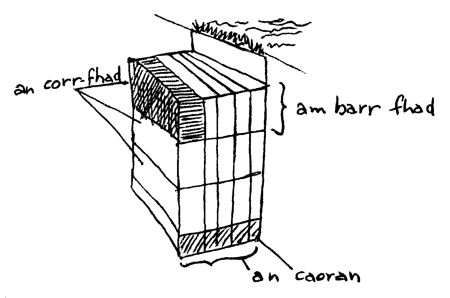
Note: a thatched house in Tiree is called ‘tigh tughadh’ and not ‘tigh tughaidh’ as is customary in some other places. [NOTE: see the illustration under ‘Old Tiree house’.]
Location: [Tiree, Scarinish]
Category: Taigh Gàidhealach / House and Furnishings
-
5. Words arranged alphabetically –
-
Location: North Uist
Category: Àiteach / Agriculture
-
Bha mi “callaigig” air
-
I was calling on him. (Stoer, Assynt)
Origin: Assynt, Stoer
Category: Biadh is Deoch / Food and Drink
-
Bha mi “callaigig” ooie
-
I was calling on her. (Stoer, Assynt)
Origin: Assynt, Stoer
Category: Biadh is Deoch / Food and Drink
-
Callainn
-
n. ‘New Year’: GIN.: Oidhche na ~ ’s ann faisg air Nollaig a bha i
Location: Canada, Cape Breton, Mira Co., Marion Bridge
Category: Word List
-
Cillbhinn
-
[NOTES: slipped under Cill-linne. Quotation: (a) Cill-linne. (b) Cillbhinn. Definition: (a) What natives called Killin in informant’s youth (circa 60-70 years ago). (b) Found nowadays.]
Origin: Kill-Fhinn
Category: Crodh / Cattle
-
Cille Mhartainn
-
In Staffin, was called after Saint Martin of Tours. There is a tradition, still strongly believed in, that whenever a grave is opened there, three burials follow in rapid succession. According to my own recollections this was invariably the case. [SLIP: In Staffin, Skye. (See Quest.)]
Origin: Skye
Category: Bàs is Adhlacadh / Death and Burial
-
D. What do you think is the English name for the plants
called in Gaelic.
-
Location: Harris, Scalpay
Category: Blàthan-Leighis / Medicinal Plants
-
D. What do you think is the English name for the plants called in Gaelic:
-
Origin: Mull, Bunessan, Ardtun, Knockan or Mull, Burg or Mull, Tobermory or Mull, Bunessan, Taoslainn
Category: Blàthan-Leighis / Medicinal Plants
-
D. What do you think is the English name for the plants called in Gaelic:
-
Origin: [Barra]
Category: Blàthan-Leighis / Medicinal Plants
-
Glasgo
-
Glasgow. Not Glascu as pronounced in most other places in the Highlands. According to Johnston’s Place Names of Scotland it was called Glasgo in 1116.
Origin: Assynt, Stoer
Category: Biadh is Deoch / Food and Drink
-
Gugaireachd
-
April Fools’ Day. Also called ‘Latha na Feachaireachd’.
Location: South Uist, Lochcarnan
Category: Measgaichte / Miscellaneous
-
Iain-nam-bròg
-
(slang, common with fishermen) wasn’t there a name used for this boot extractor. I think there was another name in the term of a word. Perhaps you remember. I cannot recall it at the moment. [NOTES: slipped under Iain-nam-brog. Definition: Name for piece of wood so shaped to help fishermen out of their boots.]
Location: Na Hearadh, Scalpaigh [Harris,Scalpay]
Category: Measgaichte / Miscellaneous
-
Ledi, Tìneag
-
using cow’s name [to call it].
Origin: Barra
Category: Crodh / Cattle
-
Mac ’ic Iain
-
“Rinn e Mac ’ic Iain dheth fhéin.” – Mhill e e fhéin, ann an dòigh sam bith. Rinn e amadan dheth fhéin. Rinn e call dha fhéin. ’S mar sin. Tha mi cinnteach gu bheil i seo anns a h-uile h-àit.
Origin: [Lewis, Uig an Iar]
Category: Measgaichte / Miscellaneous
-
Mo chreubhag!
-
Notes: Exclamation. Goodness! Good gracious! Note Iain Lom’s “… mo chreubhag làn tholl”. Source: Lewis usage recalled (D.S.T.). Date: 1974.
Location: Lewis
Category: Measgaichte / Miscellaneous
-
Ròthart nan Eun
-
same as ‘Ròthart na h-Éill Pàdruig’. ‘Ròthart’ pronounced without the ‘e’ in both North and South Uist. ‘Ròthart nan Eun’ so called since the tide would [sic] higher in the following months, therefore making it safe for birds to nest at the highest mark left by the tide.
Location: North Uist, Carinish, Cnoc Cuidhein [Knockquien]
Category: Measgaichte / Miscellaneous
-
Seasamh a mach
-
Calling the next to bear the coffin. In Barra male mourners walk in front of the coffin and the female mourners behind. Different on mainland.
Origin: Barra
Category: Bàs is Adhlacadh / Death and Burial
-
Siol-Ghall
-
[sic] “ – he whose parents were Highland on the one side and Lowland on the other – was called Sìol Ghall.” (page 271)
Origin: [Lewis, Uig an Iar]
Category: Measgaichte / Miscellaneous
-
Treas lionadh
-
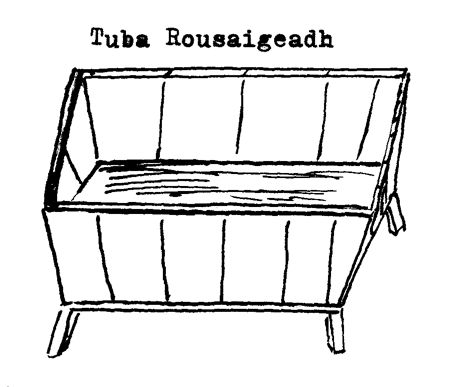
Dh’fheumte treas lionadh a dheanamh air a chula baraille agus as deidh an treas lionadh bha an ceann air a chur teann ann le bualadh sios cearcall àrd iaruinn a’ bharaille. Bha am baraille an uair sin ga chur air a chliathaich, agus air a roiligeadh le putair chun na tuba rousaigidh.
Origin: [Lewis], Dail a Tuath or [Lewis], Suaineabost [Swainbost] or [Lewis], Lional
Category: Acfhuinn Iasgaich / Fishing Tackle
-
[Rutchumas (?)
-
[?] ] She [my mother] also played a game called Rutchumas (?) with 2 teams of 6, each with a tree branch which the other team tried to capture.
Origin: Applecross [mother]
Category: Measgaichte / Miscellaneous
-
[Skye custom]
-
In Skye, whenever a friend called to see the remains, he, or she, reverently laid the right hand on the forehead of the corpse. When I enquired into the origin or reason for this custom I was assured that laying one’s hand on the dead banished from his mind ever afterwards the fear of meeting the departed’s ghost an prevented the vision of the dead person from haunting the mind.
Origin: Skye
Category: Bàs is Adhlacadh / Death and Burial
-
[Sunniva]
-
Name: Sunniva. Equivalents: Sinnie and in one instance lately Sunnivoe (Zetland). Note. The name Sunniva has practically gone out of use in Zetland as the pet-name ‘Sinnie’ is not liked, and yet in its original form it was a pretty name.
Category: Ainmean Pearsanta Bhoireannach / Female Personal Names
-
[bruich]
-
Bruich, bruich, bruich, Cuid a leanabh bhig, Leanabh beag a call a chèile ’sa chuid fhein a bruich. A little rhyme said whilst the child’s food was cooking.
Location: South Uist, Lochcarnan
Category: Measgaichte / Miscellaneous
-
[butata dubh]
-
before the Champion was introduced well over 60 years ago, a dark blue variety with blue streaked flesh, called butata dubh, was generally used.
Origin: Assynt, Stoer
Category: Àiteach / Agriculture
-
[butata]
-
potatoes are never called buntata in Assynt. Always butata. The first potatoes known in Europe were brought by the Spaniards from Quito, Peru in 1553 and were known as “battata”. Perhaps the Assynt people are Spaniards and not descended from the MacLeods of Lewis and the MacKenzies of Gairloch as we were always led to believe!!!
Origin: Assynt, Stoer
Category: Biadh is Deoch / Food and Drink
-
[bòil]
-
Chuir iad bhòil. – Bhuannaich iad seachd geamannan as déidh a cheile gun call.
Origin: [Lewis, Uig an Iar]
Category: Measgaichte / Miscellaneous
-
[call]
-
Fhuair mi am peann a bha air chall. – I found the pen which was lost (temporarily).
Origin: Lochaber
Category: Measgaichte / Miscellaneous
-
[call]
-
Fhuair mi am peann a bha air chall. – I found the missing pen.
Origin: Lochaber
Category: Measgaichte / Miscellaneous
-
[call]
-
’Ga chall fhéin. “Bha Tormod a’ cumail ris glé mhath agus glé chuimhneach gu ruige seo, ach tha e a nise air tòiseachadh ’ga chall fhéin.”
Origin: [Lewis, Uig an Iar]
Category: Measgaichte / Miscellaneous
-
[calldachd]
-
Ni mi suas do challdachd. I will recompense your loss.
Category: Measgaichte / Miscellaneous
-
[caoirthe]
-
when four or five of the peats in the ‘garradh’ [q.v.] stuck together, the whole group was called the ‘caoirthe’.
Location: Harris, Bernera
Category: Mòine / Peat-Working
-
[caorich mhor]
-
Cheviots are usually called by the English name of the breed and about 50 years ago as caorich mhor.
Origin: Assynt, Stoer
Category: Caoraich / Sheep
-
[cas-bheag]
-
When a young dog was too hasty and difficult to control, one of his front legs was put in between the [word missing] and his throat or tied up to the collar in order to slow him down and make him more biddable. This was called the ‘cas-bheag’.
Origin: Inverness-shire, Nethy Bridge
Category: Crodh / Cattle
-
[cearcall a’ bhùirn]
-
Bha mi a’ bruidhinn ri Dòmhnall Iain (…). Bha sinn a’ bruidhinn air seann rudan a bhiodh aca, agus againn, shuas ’s an eilean. Mar cearcall. Cearcall a’ bhùirn mar a chanadh na Leòdhasaich. Bha e mar seo shìos. De fhiodh. Airson na peilichean a dheanamh na b’aotrom leis an làd bhùirn. (Chuir mi a steach thugaibh e mar tha, tha mi an dùil.) Cearcall. Cearcall a’ bhùirn. Chanadh na seann fhir “a’ chuairt” ris, cuideachd. Chan eil fhios ’am de an t-ainm Albannach a bh’air.
Origin: Lewis, Uig
Category: Measgaichte / Miscellaneous
-
[ceum]
-
Cheun [sic] e gu mor mun cuairt. He stepped round majestically. [NOTE in second hand: Eng der.]
Category: Measgaichte / Miscellaneous
-
[corra-chòsag]
-
A chorra, chorra chòsag an innis thusa dhomhsa am bith latha math a màireach ann ’s bheir mi paidhir bhròg dhut.” Animal in question was a slater found under rocks. Also called ‘cailleach-òsag’ or ‘cailleach-chòsag’.
Location: South Uist, Lochcarnan
Category: Measgaichte / Miscellaneous
-
[cudag]
-
Others are scart = scarbh = parkin = partan = pickie = young saithe, also piteuchty (Girvan). This fish is the cudag – cudaige – cudann at the sprat stage and living in the harbour. We called the larger ones blockan (léiteanach? [?]). Larger still stemlet = grey fish. Could picky be from pioc nibble? Or from a totem name piocach – Pict?
Location: Prestwick
Category: Measgaichte / Miscellaneous
-
[cur]
-
A’ cur air a’ chloich – putting the stone. A’ cur air an dòrnaig – putting the stone. Tha a’ muir a’ cur orm. – I am sea-sick. A’ cur an eòrna – sowing barley. A’ cur an t-sneachd – snowing. A’ cur thairis – overflowing. A’ cur nan cleas dheth [dhith? – unclear] – gambolling. A’ cur bhuaidhe – relieving himself (call of nature). A’ cur a mach – vomiting.
Origin: Lewis, Uig
Category: Measgaichte / Miscellaneous
-
[eubh]
-
Dh’eubh e oirre a nunn ri thaobh. He called her to his side.
Category: Measgaichte / Miscellaneous
-
[foddar-barrie]
-
straw for thatching was never put through the mill. It was always threshed by the flail – tuiste [q.v.] – and called foddar-barrie.
Origin: Assynt, Stoer
Category: Àiteach / Agriculture
-
[fro-stick]
-
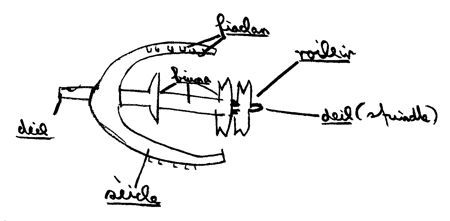
Another thing that was used in connection with milk, I do not know the Gaelic name for it but in English it is called a fro-stick. In fact we used to have one here though I have not seen it for some time. I’ll try and make a drawing of one which will give you an idea what it looked like. It was used for what we called a ‘fuarag’. This was some cream in the bottom of a flat dish or any vessel with a flat bottom, you put the fro-stick in it and kept the handle tight between the palms of the hands and made a rubbing movement causing the fro-stick to go one way then the other continuing this for about five minutes, depending on the quality of the cream, until it almost reached the stage what we called the ‘bainne-briste’ stage. ‘Bainne-briste’ was when the milk was starting to change from milk to buttermilk. The ‘fuarag’ was the stage before that when the cream went sour and this was often taken. The material which went round the four spokes was the long hard hair at the end of a cow’s tail like a rope. It didn’t fall off as the ends of the spokes were scouped out cup shaped.
Origin: Inverness-shire, Nethy Bridge
Category: Crodh / Cattle
-
[gàireachdaich]
-
A’ call a chiall a’ gàireachdaich. – Splitting his sides laughing.
Origin: [Lewis, Uig an Iar]
Category: Measgaichte / Miscellaneous
-
[hup] and
-
[vai:n] [calls to horse used when] ploughing, to go one way (furrow) and then the other (rig). Not know which. [NOTES: slipped under [v[ai]:n]. Definition: one of the calls (the other being [həp]) to a horse when ploughing, to tell it to go to furrow or rig. Not known which is which.]
Origin: Kill-Fhinn
Category: Crodh / Cattle
-
[hu̜i:dʹʒ]
-
Notes: call to ducks (repeated).
Origin: Islay, Ballygrant
Category: Measgaichte / Miscellaneous
-
[lair-chaib’]
-
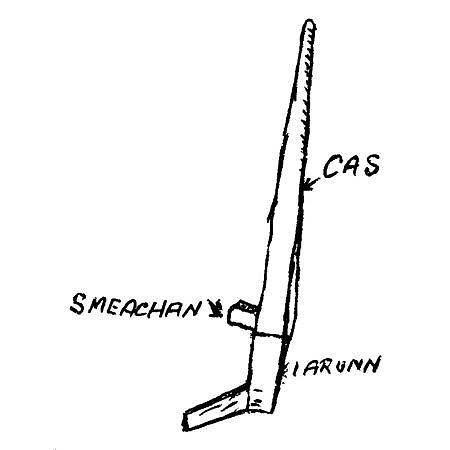
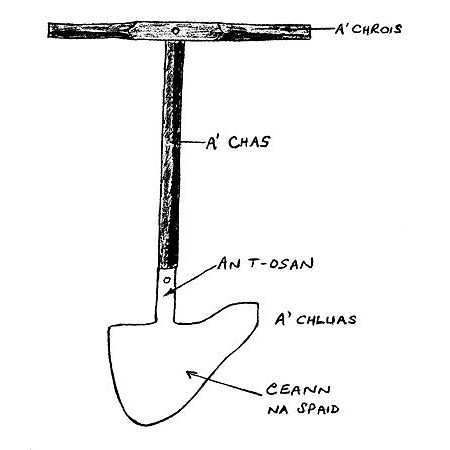
In Dwelly’s this turfing spade (for houses roofs and potato pits) is called ‘caibe làir’, but in Tiree it is always known the other way round – ‘lair-chaib’’.
Location: [Tiree, Scarinish]
Category: Taigh Gàidhealach / House and Furnishings
-
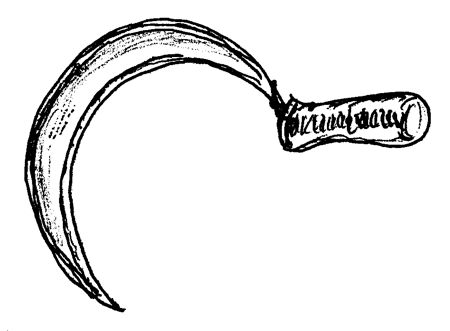
[làmh]
-
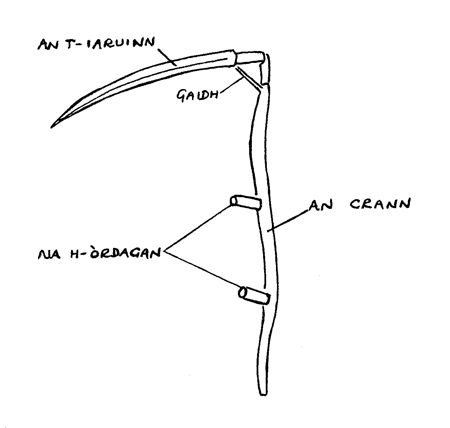
Làmh bheag, làmh mhór – terms applied to the respective hand grips on a scythe. Also called ‘dorn bheag, dorn mhór’.
Location: South Uist, Iochdar
Category: Measgaichte / Miscellaneous
-
[note]
-
(There are others [i.e. words] I have heard similarly, colloquially, I am trying to recall.)
Location: Harris, Scalpay
Category: Measgaichte / Miscellaneous
-
[note]
-
Many of the Equivalents appearing in these lists are doubtless already well-known, but I have endeavoured, from personal inquiries made mainly in Zetland and other insular parts of Northern Scotland, to furnish some fresh information on the matter. For facility of reference the English Christian names are set down in alphabetical order; and against them are shown (1) the Gaelic equivalents and (2) the English equivalents, including those which are in use in certain specified regions – together with occasional explanatory notes. In the list “Male Personal Names” the patronymics are also given – not that they may serve much useful, practical purpose, but because patronymics figure largely in our Scottish nomenclature and are interesting as derivatives from our common Christian names. From a close survey of the lists certain main inferences may be drawn: 1. The correctness of the Registrar-General’s surmise “that some names have no doubt a significance differing according to locality” is demonstrated by the following examples:– (a) Ewen and Hugh. In Lewis these two names are distinct and have separate Gaelic equivalents. (Ewen = G. Eòghann; Hugh = G. Uisdean). But in the South Isles of the Outer Hebrides the two names are interchangeable and have a common Gaelic equivalent, (both Ewen and Hugh = G. Eòghann). This fact was first brought to my notice in South Uist and I subsequently got verification of it elsewhere; one instance being that of a boy from Uist attending school at Dornie, who was known as “Hugh” at home and as “Ewen” in school. (b) Effie and Henrietta. So far as the mainland of Scotland is concerned there is, I think, no connection between these two names; yet I find in Lewis they are interchangeable, the common Gaelic equivalent being “Eighrig”. I have corroboration of this from two schoolmasters who are natives of Lewis; and I found a practical example in the case of a Lewis lady resident in Skye, whose husband calls her “Effie” but who signs her name as “Henrietta”. 2. Many of our Personal Names are merely Anglicised forms of Gaelic Names, for example: Gillespie = Archibald (from G. Gill-easbuig), Donachie = Duncan (from G. Donnchadh), Murachie = Murdoch (from G. Muireach), Ailie = Helen (from G. Eilidh), etc. etc. 3. Some of the other names are not what might be termed exact equivalents, but are distorted forms given to foreign names by Ministers who were unacquainted with the foreign language. In this class is the name “Haki” or “Hakon” which has been transformed into “Hercules”; just as “Osla” has been twisted into “Ursula” and thence into “Cecilia”. It should be understood that my inquiries have been comparatively limited and that consequently the information given here cannot be anything like exhaustive on the subject of name equivalents. But the examples given are sufficient to illustrate that many odd equivalents do exist, and that the identity of a person with whose name we are furnished may be found under an alternative name.
Category: Ainmean Pearsanta Bhoireannach / Female Personal Names
-
[prui-seog]
-
While on the subject of calling animals, the word used here for calling a horse was ‘prui-seog’, the ‘og’ the same as in ‘òg’.
Origin: Inverness-shire, Nethy Bridge
Category: Crodh / Cattle
-
[prɔkʹ]
-
[call to a] horse (to come to you). [NOTES: the slip has [prɔˈki].]
Origin: Kill-Fhinn
Category: Crodh / Cattle
-
[pɾi:jo:]
-
Notes: call for cattle.
Origin: Islay, Ballygrant
Category: Measgaichte / Miscellaneous
-
[pɾi:veɡ]
-
Notes: call to a calf.
Origin: Islay, Ballygrant
Category: Measgaichte / Miscellaneous
-
[pɾi:ʃo]
-
Notes: call to a horse.
Origin: Islay, Ballygrant
Category: Measgaichte / Miscellaneous
-
[sluichd]
-
13. Ann an oisean na SLUICHD, taobh nan clach bha toll duint le sop. Nuair a bhitis an amhrus gun robh a’ mhuileann a’ call an t-sil, chuireadh am muillear a ghairdean troimh ’n toll a’ dh’fhiachainn ceann an ROTH. Mur an robh air ceann an ROTH ach dudan bha a chuis ceart, ach ma bha gran air ceann an ROTH bha a’ mhuilean am feum air a CUBADH.
Location: [Lewis], Leurbost
Category: Muileann Lochlannach / Norse Mill
-
[slàt]
-
Slàt druime, slàtan taobh (two of these, one on each shoulder). Terms used for parts of spoon net or ‘tàbh’ as it is called in Gaelic.
Location: South Uist, Iochdar, Baile Gharbhaidh [Balgarva]
Category: Measgaichte / Miscellaneous
-
[tigh-aire]
-
In my childhood, Lochaber, i.e. the Braes of Lochaber, was 95% Catholic. When a death occurred in a house, people flocked to pay their respects and remained to pray. It was customary to lay one’s hand on the forehead of the dead for a moment (the head was normally covered by the sheet but the sheet was turned down momentarily to allow the hand to be laid on the forehead). People took it in turn to remain in the room “’s an tigh-aire” where prayers and litanies were said night and day till the day of the funeral – food was provided for people. On the day of the funeral, the coffin was carried shoulder-high on a bier for the few miles to Cill-a-Chaorail. The ancient church of St. Cyril of Alexandria has been restored of recent times and I understand the burial-service is held there now. [NOTES: the following comment copied from the letter dated 24/03/1977:] In my remarks about funeral practices in a previous letter, I had intended to mention the custom of building cairns. I have understood that when the mourners stopped for a rest and possibly refreshment, each man looked around for a sizeable stone and a cairn was built and was called the deceased’s cairn. With the widening of the roads, I fear the cairns have disappeared on the main roads.
Origin: Lochaber
Category: Measgaichte / Miscellaneous
-
[tòir]
-
Thig mi air do thòir aig aon uair. – I shall call for you at 1pm.
Origin: Lochaber
Category: Measgaichte / Miscellaneous
-
[tʹu̜k, tʹu̜k]
-
[call to] hens.
Origin: Kill-Fhinn
Category: Crodh / Cattle
-
[wit]
-
[call to a] duck.
Origin: Kill-Fhinn
Category: Crodh / Cattle
-
[əst̪ɔ̃ṉxle:]
-
Notes: warm tub or condenser in distillery. Also called [əst̪ɛ̃ṉdʹȝxle:] (A. MacEachern, Ballygrant).
Origin: Islay, Port Charlotte
Category: Measgaichte / Miscellaneous
-
[ɡɔs]
-
Notes: call to a dog (old usage).
Origin: Islay, Ballygrant
Category: Measgaichte / Miscellaneous
-
[ɡʹu̟s]
-
Notes: call to a pig (repeated).
Origin: Islay, Ballygrant
Category: Measgaichte / Miscellaneous
-
[ʃi:d̪ɑx]
-
Notes: call to cats (repeated).
Origin: Islay, Ballygrant
Category: Measgaichte / Miscellaneous
-
[ˈʃi:əɫ]
-
Notes: call to geese (repeated).
Origin: Islay, Ballygrant
Category: Measgaichte / Miscellaneous
-
[‘Na Cóig’ or a’ Ghriùthran]
-
“She [my mother] played a game called ‘Na Cóig’ or a’ Ghriùthran with five pebbles. Various moves were undertaken while tossing them, these I recollect: Cóig, Deich, Co’deug, Fichead Roisinne mhór, Roisinne bheag, Slipean mór, Slipean beag, Cóig dhuilich, Fad na h-uilinn, Cóig na cearraig, Cóig dhall, Garra mór, garra beag, Cóig an aoidh, Cóig an aoidh ’n adhar, Griùthran, Crogais mhóra, Crogais bheaga.”
Origin: Applecross [mother]
Category: Measgaichte / Miscellaneous
-
a chaoit!
-
Quotation: calling ducks.
Location: Skye, Strath
Category: Measgaichte / Miscellaneous
-
an cearcall (m)
-
iron tyres (hoop / ring).
Origin: Tiree
Category: Àiteach / Agriculture
-
an dorus mór
-
the main door as opposed to the back door which led into the barn and was called ‘dorus an t-sabhail’.
Origin: Eileanaich [natives of Lewis]
Category: Taigh Gàidhealach / House and Furnishings
-
an luchd faire
-
The wake folk, usually men who were neighbours of the dead, although there were several women present also who provided and served meals as there was feasting going on through the night. This has practically ceased and feasting has given place to a religious service, reading of scripture, singing of Psalms and prayers, each night as long as the dead body is in the house. [NOTES: slipped under ‘luchd faire’. Definition: The wake folk. (See Quest.)]
Origin: Skye
Category: Bàs is Adhlacadh / Death and Burial
-
an t-slabhraidh
-
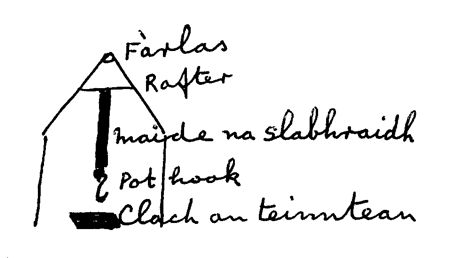
The long iron chain which was suspended from the rafter, immediately above the fire. The lower link or links of chain held the pot-hook. Through the years, a thick layer of soot accumulated on this chain, and its whole length from pot-hook links to its end which was tied to rafter was called ‘maide na slabhraidh’.
Origin: Skye
Category: Taigh Gàidhealach / House and Furnishings
-
an tòc
-
This is a mystery somewhat akin to the King’s Evil, only in this instance, animals are the sufferers. An operation is performed on the eye of the animal (sheep or cow). The eyelid is turned outwards and by means of a darning needle and a piece of thread, some particular part surrounding the eye is manipulated so that it can be cut off. This gives immediate relief to the animal. Veterinary surgeons do not believe in it. An instance was quoted to me last summer. The man telling the story told me he had been to a village in Lochs. There was a cow, very far through, stretched out on the ground practically at its last gasp when my friend arrived. The vet had been called and had given her up as hopeless. My friend asked, “Na dh’fhiach sibh bheil an tòc oirr?” “Chan eil fhios againne dé th’ann an tòc.” “Uill bheir mise an tòc bhair na bà agus mur a dèan e feum, cha dèan e cron ’sam bith oirre co dhiubh.” He performed the operation and in ten minutes’ time the cow was on its feet and eating the grass. The amazing thing is that the people of Lochs had never heard of this most effective operation which is still regularly performed in Uig.
Origin: Lewis, Uig
Category: Measgaichte / Miscellaneous
-
an àrc
-
a hollow near a cow’s tail by which you can judge when the cow is likely to calve. Also called ‘sloc an airich’.
Location: South Uist, Lochcarnan
Category: Measgaichte / Miscellaneous
-
ascall
-
loss of cattle in the spring.
Location: South Uist, Garrynamonie
Category: Measgaichte / Miscellaneous
-
ath-cheapach
-
Notes: when lea land is ploughed one year, called ath-cheapach before being ploughed the following year.
Location: Skye, Kilmuir
Category: Measgaichte / Miscellaneous
-
ath-foin (phonetically spelt ath-mhoine)
-
big wet peats set aside to dry.
Location: Lewis, Lochs, Leurbost
Category: Mòine / Peat-Working
-
athais
-
[ɑhiʃ] Quotation: Mas na poit a’ cuir athais air bathais na slabhraidh. Notes: The pot calling the kettle black.
Location: Ross-shire, Polbain
Category: Measgaichte / Miscellaneous
-
a’
-
[kɑ̃ĩliɡʹəɣ] Quotation: a’ [kɑ̃ĩliɡʹəɣ] ri chéile. Notes: competing physically to see who would be finished first, e.g. scything, running, etc.
Origin: North Uist
Category: Measgaichte / Miscellaneous
-
a’ cruachadh
-
building into seven foot ‘beehive structures’; this will be brought home at the woman’s leisure during good days in Autumn, Winter and Spring; few do this nowadays. Their work on the ‘sliabh’ halts at ‘tòrr’ [q.v.] at which stage the tractor is called into action.
Origin: Leódhas, An Rudha [Lewis, Rudha]
Category: Mòine / Peat-Working
-
a’ dlìgheach
-
about to vomit, what we call ‘boaking’ in Scots.
Origin: Applecross [mother]
Category: Measgaichte / Miscellaneous
-
bacan cuil
-
[bɑ˖xkɑ˖n kuulʹ] Notes: sheep marking called “back half”.
Location: Ross of Mull
Category: Measgaichte / Miscellaneous
-
bacan àrd
-
[bɑ˖xkɑ˖n ɑɑ˖ʂd] Notes: sheep marking called fore half.
Location: Ross of Mull
Category: Measgaichte / Miscellaneous
-
baigeileis
-
[bɑɡʹəlɛʃ] Quotation: a’ bhaigeileis. Notes: when the raw wool was teased, the dirty wool was put into a bag called a’ bhaigeileis. (Could also be used of a dirty, ragged person.)
Location: Skye, Stein
Category: Measgaichte / Miscellaneous
-
baisteadh
-
Quot.: a’ baisteadh. Note: practice at one time of dipping newly-made clay vessels in milk. Milk called “boinne-baist”.
Origin: [Barvas]
Category: Measgaichte / Miscellaneous
-
bancas
-
played by school-boys on lazy-beds. One boy on the middle lazy-bed and a team of boys on another trying to get across to the 3rd lazy-bed without the boy on the middle one touching them. If he happened to touch one, he was dismissed. Again the former word used for the same pastime was dad-oighridh. Perhaps meaning ‘to your estate’. Thus do d’ oighreadh or oighridh – to your estate. This was the way I take it to be pronounced. The word has died colloquially. [SLIP: A game played by boys on lazy-beds. One boy would stand on the middle lazy-bed while a team of boys starting from another lazy-bed tried to cross the middle one to a third one without the boy in the middle touching them. If someone was ‘tagged’, he was out of the game. Used to be called ‘dad-oighridh’ – ‘to your estate’?]
Location: Na Hearadh, Scalpaigh [Harris, Scalpay]
Category: Measgaichte / Miscellaneous
-
baobh
-
[bɤ:v] Notes: a “rascally” female.
Location: Skye, Kyleakin
Category: Measgaichte / Miscellaneous
-
barp
-
an accumulation of stones beside lochs. Examples found locally at Milton and Lochboisdale. People are supposed to be buried underneath these rocks. Associated with the distant past.
Location: South Uist, Milton
Category: Measgaichte / Miscellaneous
-
barradh
-
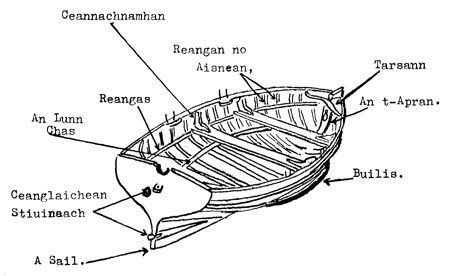
once the tummers had been riveted together with the nails, their ends were cut off and what was left of the nails was flattened against the timber. This flattening of the nail was called ‘a barradh nan tàirnean’. Had to be careful not to be too over zealous in this task and indeed if the nails were too tightly clenched against the tummers the boat could come apart on being put in water. There had to be a certain breathing space between the timber and the nail.
Location: Eriskay, Na Hann [Haun]
Category: Measgaichte / Miscellaneous
-
bathais
-
Quotation: Màs na poit a’ cur athais air bathais na slabhraidh. Notes: The pot calling the kettle black.
Location: Ross-shire, Polbain
Category: Measgaichte / Miscellaneous
-
beag-lochd
-
Quotation: ’Se duine beag-lochd a bh’ann. Notes: More complimentary than ‘innocuous’. Not in Dw. Source: Lewis usage recalled (D.S.T.) Date: 13/2/1972.
Location: Lewis
Category: Measgaichte / Miscellaneous
-
bealach, beàrrlach
-
of the scallop family. [SLIP 1: Bealach. Of the scallop family. Cf. beàrrlach.] [SLIP 2: Beàrrlach. Of the scallop family. Cf. beallach.]
Location: Na Hearadh, Scalpaigh [Harris, Scalpay]
Category: Measgaichte / Miscellaneous
-
beum
-
[bẹẹm] Notes: sheep marking called “bit”.
Location: Ross of Mull
Category: Measgaichte / Miscellaneous
-
bialag
-
When peats were put on a fire, the live cinders were not wholly covered right round. An opening was left in front (where a current of air would soon kindle a flame) and let out the heat. This opening was called a ‘bialag’.
Origin: Skye
Category: Taigh Gàidhealach / House and Furnishings
-
biatachd
-
a little feast. Martin calls it ‘ocean feast’.
Location: Killearnan
Category: Measgaichte / Miscellaneous
-
bliadhna
-
n. ‘year’: bhiodh tu ’ call … dhà no thrì ’n ath bh.-s’ [naflənəs]
Location: Canada, Cape Breton, Inverness Co., Dunvegan
Category: Word List
-
bocadaich
-
Quotation: A’ leumadaich ’s a’ bocadaich. Notes: Not in Dw. Cf. bocadh ‘leaping, skipping’. Source: Lewis usage recalled (D.S.T.) Date: 1972.
Location: Lewis
Category: Measgaichte / Miscellaneous
-
brolais
-
Quotation: a’ brolais. Notes: talking nonsensically.
Location: Ross-shire, Aultbea
Category: Measgaichte / Miscellaneous
-
bròg-ghlaodh
-
Note: said that these were made in his father’s time from “guttapercha” – a resin-like substance that used to come ashore. Called by them [kɑd̪ɑbɤɾkɑ]. Sometimes shinty balls were made from it.
Origin: Uig
Category: Measgaichte / Miscellaneous
-
buabhall
-
The cow’s bed was called a ‘buabhall’, a good Gaelic word for stall.
Origin: Skye
Category: Taigh Gàidhealach / House and Furnishings
-
buaic
-
The wick of a ‘cruisgean’ [q.v.] was called a ‘buaic’ and must on no account be called a ‘siobhag’. The name ‘buaic’ is most expressive and specific and means exactly what it was, something soaked in oil or grease, a ‘siobhag’ on the other hand is not very specific and could mean a bit of any kind of rag. ‘Siobhag’, again, is of fairly modern coinage and came into use when paraffin lamps were introduced into Gaeldom. ‘Buaic’ was made of the inside of rushes. The whole of this wick was submerged in the oil of cruisie, the other end, which was lit, lay along the upper spout. As a cruisie had no screw on it, a long, sharp bodkin lay near and was used to move the ‘buaic’ up into spout periodically as flame wore it out. ‘Buaic’, a very ancient name.
Origin: Skye
Category: Taigh Gàidhealach / House and Furnishings
-
buail
-
Quot.: “Buaileam ort!” Note: when two people were to pick opposing teams, one would call “Buaileam ort!” The second would then say “Leigeam leat!” and the first would pick his first choice. (Two shinty teams.)
Origin: Uig
Category: Measgaichte / Miscellaneous
-
buailtean-calltuinn
-
Category: Àiteach / Agriculture
-
bucall
-
(m) Hook or buckle thro’ which strap for tying hames (at top) passes. [NOTES: spelled ‘bucal’ on the slip.]
Category: Àiteach / Agriculture
-
bug
-
(interj.) calling hens to food. bug! bug! bug! [NOTES: slipped under ‘bug! bug!’.]
Location: Na Hearadh, Scalpaigh [Harris, Scalpay]
Category: Measgaichte / Miscellaneous
-
buill’-og
-
when a flat stone was thrown on the water, it bounced off two or three times, and sometimes skimmed along the surface. This we called ‘buillog’ [sic].
Origin: Lewis, Uig
Category: Measgaichte / Miscellaneous
-
bunabhuchaille
-
Notes: says it’s a bird called the loon.
Location: Canada, Cape Breton, Boisdale
Category: Measgaichte / Miscellaneous
-
buntàta
-
Quotation: buntàta nan creag. Notes: a red and yellow spot which grows usually where a stone breaks the surface of the ground. Grows on this thin layer of earth. (Also called Buntàt’ a’ Mhadaidh Ruaidh.)
Origin: North Uist
Category: Measgaichte / Miscellaneous
-
buthaid
-
puffin. Also called ‘peata ruadh’.
Origin: Glasgow/South Uist? or South Uist, Kildonan or South Uist, Garrynamonie or South Uist or Skye, Bernisdale
Category: Measgaichte / Miscellaneous
-
buthaman
-
bowman potatoes. So called after a ship ran aground at Paible with a cargo of this potato. The captain of the ship was called Bowman.
Location: North Uist, Iollathraigh [Illeray]
Category: Measgaichte / Miscellaneous
-
buthta pucall
-
applied to a fat, useless person.
Location: South Uist, South Boisdale
Category: Measgaichte / Miscellaneous
-
bàrr
-
[bɑɑ˖r] Notes: sheep marking called ‘crop’.
Location: Ross of Mull
Category: Measgaichte / Miscellaneous
-
bùrn-an-iaruinn
-
(perhaps noted already) (also) water of a chemical sort of scum on the surface resembling iron: rusty appearance. [NOTES: slipped under ‘bùrn’ and ‘iarunn’ with ‘bùrn an iaruinn’ as the quotation. Definition: Water with a chemically-caused scum (of rusty appearance) on the surface.]
Location: Harris, Scalpay
Category: Measgaichte / Miscellaneous
-
bùtarais (f)
-
Quotation: Rinn e b. uabhcall [?] e. Notes: a mess.
Location: Harris, Ardhasaig
Category: Measgaichte / Miscellaneous
-
cabar
-
when a new creel was being made, the stakes (of willow) were called ‘cabair’. Cabair a’ chleibh.
Location: Cinntire, An Ceann a Deas [Kintyre, Southend by Campbeltown]
Category: Mòine / Peat-Working
-
cailid
-
[kɑlidʹ] Notes: fence, hedge. [NOTES: slipped under ‘callaid’.]
Location: Canada, Cape Breton, Boisdale
Category: Measgaichte / Miscellaneous
-
cailleach
-
Notes: a “granny” on a chimney-pot. So called from shape? A cowl. Cf. Cailleach-iaruinn.
Location: Tiree, [Caolas? – one slip]
Category: Measgaichte / Miscellaneous
-
caise Calluinn
-
a special cheese made at Christmas period.
Location: Barra, Ard Mhinish
Category: Measgaichte / Miscellaneous
-
call
-
nn ‘loss’: dh’fhaodadh e an cur air ch.
Location: Canada, Cape Breton, Broadcove
Category: Field Notebooks of Seosamh Watson June-August 1983
-
call
-
n. ‘loss’: duine sam bith air an tigeadh ~ mòr
Location: Canada, Cape Breton, Mira Co., Marion Bridge
Category: Word List
-
call do shuim
-
wasting your time.
Location: South Uist, Garrynamonie
Category: Measgaichte / Miscellaneous
-
calla
-
Quotation: call’ fhaoileag [kɑɫw:lɑɡ]. Notes: flock of seagulls on the surface of the water where there is a shoal of herring. [NOTES: slipped under ‘cala’.]
Location: Skye, Sleat, Calligary
Category: Measgaichte / Miscellaneous
-
calla
-
[kɑɫə] Quot.: Có am ministear dhan tug sibh calla? Note: a “call” to a congregation.
Origin: Kershader
Category: Measgaichte / Miscellaneous
-
callaid
-
any form of surround, railing, etc. Also in the sense of a hedge.
Location: South Uist, Lochcarnan
Category: Measgaichte / Miscellaneous
-
callaid
-
busy. Tha e anns an aon challaid gun sgur.
Location: Harris, Scalpay
Category: Measgaichte / Miscellaneous
-
callaidh
-
Quotation: a’ challaidh [əxɑɫɑi]. Notes: partition. [NOTES: slipped under ‘càlaidh’.]
Origin: Islay, Port Charlotte
Category: Measgaichte / Miscellaneous
-
callain
-
fat.
Location: North Uist, Grimsay, Gearradh Dubh
Category: Measgaichte / Miscellaneous
-
callaisteach
-
[kɑɫɑʃtʹɑx] Quot.: “àite callaisteach”. Note: a place which is exposed to the elements.
Origin: Caversta
Category: Measgaichte / Miscellaneous
-
callan
-
continuity.
Location: Na Hearadh, Scalpaigh [Harris, Scalpay]
Category: Coltas an Duine / Personal Appearance
-
callan
-
continuation. Thug e callan air. – continually referring to the one subject.
Location: Na Hearadh, Scalpaigh [Harris, Scalpay]
Category: Measgaichte / Miscellaneous
-
callanas nam ban
-
not sure of exact meaning but thinks it refers to the heroic effort of women who worked when their husbands went off to the fishing or to a war.
Location: South Uist, Stilligarry
Category: Measgaichte / Miscellaneous
-
callduin
-
a type of tree. Is it the hazel?
Location: South Uist, Lochcarnan
Category: Measgaichte / Miscellaneous
-
calleachail
-
clumsy.
Location: Na Hearadh, Scalpaigh [Harris, Scalpay]
Category: Coltas an Duine / Personal Appearance
-
calltach
-
Quotation: beothaichean calltach. Notes: destructive. [NOTES: slipped under ‘calldach’.]
Location: Raasay
Category: Measgaichte / Miscellaneous
-
calltainn
-
nn f. ‘hazel’: cnothan ~ [k h rɔ-ən k h auʁ̫tiɲ]
Location: Canada, Cape Breton, Broadcove
Category: Field Notebooks of Seosamh Watson June-August 1983
-
callte
-
[kɑ̟u̜ɫtə]
Location: North Argyll
Category: Measgaichte / Miscellaneous
-
calltuinn
-
Location: Mull [see below for details]
Category: Measgaichte / Miscellaneous
-
calltuinn
-
Location: Mull [see below for details]
Category: Measgaichte / Miscellaneous
-
calltuinn, snodhach, cro
-
Location: Mull [see below for details]
Category: Measgaichte / Miscellaneous
-
calltunn
-
hazel.
Location: Argyll, Tarbert, Muasdale
Category: Measgaichte / Miscellaneous
-
caoin
-
Notes: practically same word in Greek and Hebrew – cognates.
Origin: Skye
Category: Measgaichte / Miscellaneous
-
caol-druim
-
(one example) I have the most rare usage of meaning on the page previous [caoldrama?]. A common word in the physical sense. I have heard it used colloquially in the past days in the previous sense. There are the variations in meanings, as you will no doubt understand yourself that I only give the one meaning or sometimes two in my [?] collection, omitting the gender and tense, nouns, adj., and all the terms denoting cases etc., etc., grammatical ‘abbreviations’ and so on and so forth. Anyway, I am leaving this to yourself, and all the material I have here is the present words found in the speech of the people on Scalpay, but perhaps a few words of former days. I haven’t approached a dictionary so far, but what I am trying to recall from memory, but a word or two I have defined as ‘documented’ from the ‘passing peep’ in a phrase, or a passing look so to speak. This is the way I am trying to expand on at the moment. DRM
Location: Na Hearadh, Scalpaigh [Harris, Scalpay]
Category: Measgaichte / Miscellaneous
-
casan searraich
-
previously described under ‘casan cainnbe’. Called ‘casan searraich’ since the sun rays look like the feet [of] a foal when newly born.
Location: North Uist, Grimsay, Cnoc Cuidhein [Knockquien]
Category: Measgaichte / Miscellaneous
-
cat-dubh
-
Note: fish similar to the “garran-creige” [q.v.] but larger. Prominent teeth. (Variety called “cat-dearg” also found.)
Location: [Lewis], [S.] Lochs, Gravir
Category: Measgaichte / Miscellaneous
-
ceaba
-
a heavy, unwieldy spade was usually so called.
Origin: Lewis, Uig
Category: Measgaichte / Miscellaneous
-
ceaba làir
-
turfing-spade (not used now locally).
Location: Lewis, Lochs, Leurbost
Category: Mòine / Peat-Working
-
ceabal
-
a family relique [sic]. Burial plot. In South Boisdale this name is applied to an old graveyard where Protestants were buried. Traditionally called ‘cladh a’ bhrosguil’.
Location: South Uist, Milton
Category: Measgaichte / Miscellaneous
-
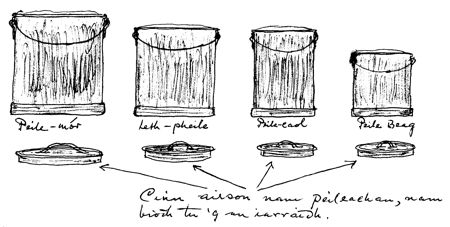
ceada
-
a wooden pail, very sturdy, with iron hoops and an iron handle which had a wooden roller in the centre. This roller was the ‘grip’. These wooden pails were not made locally – they were bought in the shops.
Origin: Leodhas [Lewis], Uig
Category: Crodh / Cattle
-
ceann-an-duine-mharbh
-
Notes: used locally for sea-urchin.
Origin: Coigach
Category: Measgaichte / Miscellaneous
-
ceapadh
-
in the sense of being tripped up both physically and in the sense of being tripped up in your conversation.
Location: South Uist, Stoneybridge
Category: Measgaichte / Miscellaneous
-
cearcall
-
[kEərkəɫ] Quotation: cearcall cartach.
Location: Mull
Category: Measgaichte / Miscellaneous
-
cearcall
-
Quotation: cearcall màis, cearcall meadhoin, cearcall mullaich. Notes: hoops on a barrel.
Location: Skye, Kyleakin
Category: Measgaichte / Miscellaneous
-
cearcall
-
iron band used for strapping cartwheels.
Location: North Uist, Iollaraigh [Illeray]
Category: Measgaichte / Miscellaneous
-
cearcall
-
[ke̜rkəɫ] Quotation: cearcall cartach. Notes: the iron tyre on the outside of a cart wheel.
Location: Ross of Mull
Category: Measgaichte / Miscellaneous
-
cearcall
-
[kɛrkɤɫ] [?] Notes: square wooden frame for carrying 2 pails of water; the frame kept the pails from bumping against the carrier’s sides. Common to Embo, Golspie, and Brora. Source: Mr and Mrs Kenneth MacKay, 16 Gate St., Embo. Date: autumn 1967.
Location: Sutherland [see below]
Category: Measgaichte / Miscellaneous
-
cearcall
-
[cɑɾkəɫ] Quotation: cearcall na cuibhle. Notes: iron rim of cartwheel.
Origin: Glenurquhart
Category: Measgaichte / Miscellaneous
-
cearcall
-
Notes: iron rim of cartwheel.
Origin: Islay
Category: Measgaichte / Miscellaneous
-
cearcall
-
Quotation: cearcall a’ ghrìs. Notes: circular plate on the hub of a cartwheel to keep the grease in.
Origin: Islay
Category: Measgaichte / Miscellaneous
-
cearcall
-
iron ring on wheels.
Origin: Ross and Cromarty, Lewis
Category: Àiteach / Agriculture
-
cearcall [?]
-
Iron hoop on wheel. [NOTES: the last ‘l’ seems to have been crossed out.]
Category: Àiteach / Agriculture
-
cearcall a’ bhùirn
-
Bhiodh seo againn airson ar cuideachadh le na peilichean bùirn a’ tighinn as an tobair. Bha e mar seo shìos: [see illustration]. ’Se fiodh a bh’ann agus bha cuideachadh mór ann airson falbh le na peilichean. Chanadh sinn “Thoirt leat an cearcall”. Chanadh na seann fhir “a’ chuairt” ris, cuideachd. Tha mi deanamh a mach gu bheil e dol fhathast ann an àiteachan an Alba.
Origin: [Lewis, Uig an Iar]
Category: Measgaichte / Miscellaneous
-
cearcall meadhon
-
Notes: the Equator.
Origin: Skye
Category: Measgaichte / Miscellaneous
-
cearcall na cuibhle
-
Iron hoop on wheel.
Category: Àiteach / Agriculture
-
cearcall-bùirn
-
Bha seo air a dhèanamh de phìosan fiodha mar a tha agam anns an dealbh-tharruing. Bha e airson na peilichean bùirn a chumail air falbh bho do thaobh gus nach fliuchadh iad thu. Cuideachd, bha na peilichean (an làd bùirn) na b’fhasa an ghiùlan [sic] leis a’ chearcall; bha iad a’ faireachduinn móran na b’aotroma. Chanadh iad “a’ chuairt” cuideachd, ris a’ chearcall-bhùirn, mar: “An d’thug thu leat a’ chuairt?”
Origin: [Lewis, Uig an Iar]
Category: Leabhar Deilbh / Drawing Book
-
cearcall-sìthche
-
fairy-ring.
Location: Na Hearadh, Scalpaigh [Harris,Scalpay]
Category: Measgaichte / Miscellaneous
-
ceathramh na roth
-
the wheel was divided into four before the spokes were inserted, one of these segments called a ‘ceathramh’.
Location: South Uist, Frobost
Category: Measgaichte / Miscellaneous
-
ceis mhòna
-
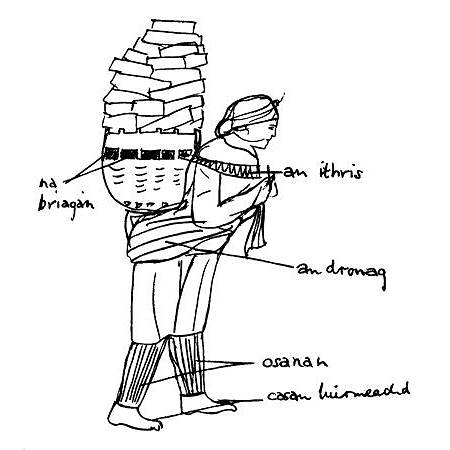
a large basket made locally for carrying peats on the back.
Origin: Lochaber
Category: Measgaichte / Miscellaneous
-
ceum gathais
-
large footprints found in rocks in islands off North Uist. Apparently belonged to the feet of the druids and are called wisdom steps.
Location: North Uist, Iollathraigh [Illeray]
Category: Measgaichte / Miscellaneous
-
cham
-
Notes: Used as a negative reply to a request e.g. “Falbh ’s dean sin dhomh.” “Cham.” Boy’s nickname: Calum Cham. Not in Dw. Source: Point (Lewis) usage recalled (D.S.T.) Date: July 1974.
Location: Lewis
Category: Measgaichte / Miscellaneous
-
ciadhàir
-
quire (choir?) yarn brought from mainland. Also called sioman Thearlaich.
Origin: Na Hearadh [Harris]
Category: Taigh Gàidhealach / House and Furnishings
-
cialla
-
clew. We have it in this form, I am not sure of my spelling here. I’ll try phonetically, thus: caidhlea? [NOTES: the slip is among the “Doubtful” words. Catch-word: caidhlea. Definition: Clew.]
Location: Na Hearadh, Scalpaigh [Harris, Scalpay]
Category: Measgaichte / Miscellaneous
-
cioch dhearg
-
Notes: sea anemone. Sometimes called “cioch a’ chladaich”.
Location: Harris
Category: Measgaichte / Miscellaneous
-
ciora
-
[ciɾə] Note: motherless lamb brought up with a bottle. Also [ciɾə] [ciɾə] – call to a sheep.
Location: Lewis, Uig, Crowlista
Category: Measgaichte / Miscellaneous
-
ciora ciora ciora
-
call addressed to lamb or sheep.
Origin: [the questionnaire gives Ross and Cromarty but it is most probably meant as the county not origin]
Category: Caoraich / Sheep
-
ciora, ciorag
-
call addressed to a lamb or sheep. “Trobhad, ciorag.” “Trobhad, ciora.”
Origin: Leòdhas [Lewis], Uig an Iar
Category: Caoraich / Sheep
-
cioraidh
-
a call to summon sheep or lambs.
Location: South Uist, Garrynamonie
Category: Measgaichte / Miscellaneous
-
ciosa, ciosa, ciosa
-
call to a lamb. Heard Kishmul Castle built on the rock Steinn was derived from ciosa-maol – enough growth there to support one hornless pet lamb.
Origin: Barra
Category: Caoraich / Sheep
-
cirain
-
a call to attract a ram’s attention. This word is repeated a number of times.
Location: South Uist, Garrynamonie
Category: Measgaichte / Miscellaneous
-
cire
-
Quotation: cire, cire! Notes: call to a sheep.
Location: Canada, Cape Breton, Antigonish
Category: Measgaichte / Miscellaneous
-
cire
-
[cıɾə] Note: cireachan [cıɾɔxəṉ] in plural. Term used for lambs from the time they are taken in for winter feeding till they go back to the moor. Then called “othaisgean”.
Origin: Ness
Category: Measgaichte / Miscellaneous
-
cire, cire
-
call to sheep.
Origin: [Skye, Camus Chroise]
Category: Caoraich / Sheep
-
cirean, cirean
-
call to lamb.
Origin: [Skye, Camus Chroise]
Category: Caoraich / Sheep
-
ciridh
-
call addressed to a lamb or sheep.
Origin: [Arran]
Category: Caoraich / Sheep
-
clach chearcall
-
a large, flat rock used in process of making cart wheels. Indentation made in the centre of the rock where the hub of the wheel was lodged. The iron hoop when heated would be placed round the frame.
Location: North Uist, Iollaraigh [Illeray]
Category: Measgaichte / Miscellaneous
-
clacharan tràigh
-
stonechats assembling on the rocks on the shore in the autumn are called this.
Origin: [Kintyre, Tarbert]
Category: Measgaichte / Miscellaneous
-
cleit
-
Quot.: na cleiteachan. Note: applied to hillocks locally.
Origin: Carloway, Doune
Category: Measgaichte / Miscellaneous
-
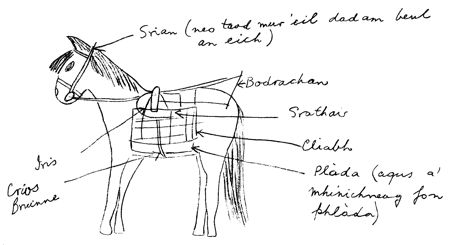
cliabh-ghiomach (E)
-
Pàirtean: Am bottom (E). (Chan e an t-ùrlar a chanas sinn idir.) [NOTES: slipped under ‘bottom’. Definition: An t-ùrlar aig a’ chliabh-ghiomach.] Cearcaill, cabair (cha chreid mi nach canadh iad an dà chuid). [NOTES: slipped under ‘cearcall’ and ‘cabar’ respectively.] Taobhan (E). [NOTES: slipped.] An gath-droma (E). [NOTES: slipped.] Sreang (I) a’ bhiathaidh. [NOTES: slipped under ‘sreang’.] A’ chlach (I). [NOTES: slipped under ‘clach’.] An dorus-beag (E). (Air a dhùnadh le sreing.) [NOTES: slipped.]
Origin: Leòdhas [Lewis], Uig an Iar
Category: Acfhuinn Iasgaich / Fishing Tackle
-
cliseach
-
Quot.: “Bheir mis’ air do chliseach!” Note: warning given to children. The back. MML, Uig has it for the back of a cow. Sometimes, he says, it is called “cliseach an droma” so it may be a certain part of the back. (Also used in Barvas for cattle.)
Origin: [Barvas]
Category: Measgaichte / Miscellaneous
-
clobhta-sgùraidh
-
rubbing (scrubbing) cloth. Metaphorically speaking: Rinn e clobta[sic]-sgùraidh dhiom. [NOTES: originally the headword was spelled ‘clobta-sgùraidh’ just like the word in the example. Then it was corrected to ‘clobhta-sgùraidh’ but the example was left unchanged, possibly through an oversight.]
Location: Na Hearadh, Scalpaigh [Harris, Scalpay]
Category: Measgaichte / Miscellaneous
-
clomhan
-
a wooden latch on a door. Bit of wood, twelve inches or more in length placed across the the [sic] door. String attached to this and pushed through a hole in the wood. Latch could be lifted like this. Others call this a ‘gliongag’.
Location: South Uist, Kildonan
Category: Measgaichte / Miscellaneous
-
cluasag
-
scallop.
Origin: Lewis, Uig
Category: Measgaichte / Miscellaneous
-
clàr-achduinn
-
a shelf on a boat on which the ship’s gear is stored, or kept; also a board on which ointment was mixed in olden days, in the Highlands of Scotland, when ointment cures were the chemistry of these days, done in the home, or locally.
Location: Na Hearadh, Scalpaigh [Harris, Scalpay]
Category: Measgaichte / Miscellaneous
-
clàtair
-
A strong hoe-like implement with concave blade called bas. [NOTES: spelled ‘clatair’ on the slip.]
Category: Àiteach / Agriculture
-
clòsaid
-
closet. Also called ‘cùlaiste’.
Origin: Na Hearadh [Harris]
Category: Taigh Gàidhealach / House and Furnishings
-
cnaidsaireachd
-
prior to the modern established trade of a joiner in these islands this is a word people used when referring to someone who was always working with wood. “Bha e a’ cnaidsaireachd air cùl an taighe.” Obviously not considered as a viable occupation, even if you were doing odd jobs for neighbours, which was also called ‘cnaidsaireachd’.
Location: North Uist, Lochportan
Category: Measgaichte / Miscellaneous
-
coigreach
-
crozier of St. Fillan, custodians of which were Dewars of Glendochart also called “Fearachd”, see “Deoraich na Fearachd”. The relic was present at Bannockburn. Found in Canada where taken by custody 1870. Now in Edinburgh.
Location: Skye
Category: Measgaichte / Miscellaneous
-
coileach an teas
-
Notes: when day is hot, and the heat shimmers, the illusion is called coileach an teas.
Location: [see below]
Category: Measgaichte / Miscellaneous
-
colthas
-
Quotation: Bha colthas eagalach oirre. – ‘She was in a terrible flurry.’ Notes: colthas is also used in the normal sense (= coltas). Not in Dw. Source: Lewis usage recalled (D.S.T.) Date: July 1973.
Location: Lewis
Category: Measgaichte / Miscellaneous
-
corca fìrean
-
oats that grew of their own accord with no seed having been planted. Also called ‘corca coimheach’. [NOTES: ‘fìrean’ corrected to ‘fireann’.]
Location: South Uist, Garrynamonie
Category: Measgaichte / Miscellaneous
-
cramaill
-
someone with a deformity. D. W. recalls someone who was called by this name since she was not 100% mentally fit.
Location: South Uist, Peninerine
Category: Measgaichte / Miscellaneous
-
crann Gàidhealach
-
all iron 2 horse plough with cast iron mould board (sgiath). Had wooden handles locally made.
Origin: Tiree
Category: Àiteach / Agriculture
-
crann speal
-
the wooden part of a scythe. Specifically just below the handles and extending to the blade.
Location: South Uist, South Lochboisdale
Category: Measgaichte / Miscellaneous
-
crann tràigh
-
“… that the fairy cross was also called crann tràigh.” (page 220)
Origin: [Lewis, Uig an Iar]
Category: Measgaichte / Miscellaneous
-
creachan
-
clam, scallop.
Location: An t-Eilean Sgiathanach, Portrìgh [Skye, Portree]
Category: Maorach / Shellfish
-
creachan, slige chreachain
-
22 [Mussels and Scallops].
Location: Mull [see below for details]
Category: Measgaichte / Miscellaneous
-
creachann
-
scallop (known also as clam). [SLIP: Scallop.]
Location: Na Hearadh, Scalpaigh [Harris, Scalpay]
Category: Measgaichte / Miscellaneous
-
creachann
-
scallop/clam.
Location: Harris, Scalpay
Category: Measgaichte / Miscellaneous
-
creachann
-
clam, scallop.
Location: Uibhist a Tuath, Ceann a Bhàigh [North Uist, Bayhead]
Category: Maorach / Shellfish
-
criather
-
sieve. (Stoer, Assynt) Latterly hand-turned fanners were used and merely called by the English name.
Origin: Assynt, Stoer
Category: Àiteach / Agriculture
-
crookie
-
English word describing a hook with a wooden handle used to lift rocks which sat unevenly. Would be levelled by wedges. Some masons called this the ‘cromag’.
Location: South Uist, Milton
Category: Measgaichte / Miscellaneous
-
cruach
-
Quot.: a’ chruach Rosach [rɔsɑx]. Note: cornstack with eaves. Called this in Ness. Probably someone called Ross introduced it.
Origin: Ness
Category: Measgaichte / Miscellaneous
-
cràgaisg
-
[kɾɑ:ɡıʃɡʹ] Note: what he calls the stick jutting up from the end of the black-house roof, round which the rope to hold the end-thatch is put.
Location: Harris
Category: Measgaichte / Miscellaneous
-
cuagach
-
Notes: deformed physically, twisted.
Location: Ross-shire, Polbain
Category: Measgaichte / Miscellaneous
-
cuirm
-
a feast. MacCodrum has ‘cuilm’. Dioscorides says that the ancestors of the Britons drank a strong liquor made of barley which they call ‘curmi’. So the word has come down to our time and whisky now so called is an ancient beverage.
Location: Killearnan
Category: Measgaichte / Miscellaneous
-
cusg
-
(coosg) people in the village of Carishader call the artificial insemination man ‘Bodach na cusg’. I never heard the word until last summer.
Origin: Lewis, Uig
Category: Measgaichte / Miscellaneous
-
cìop
-
turfs which were taken home and used for keeping the fire alive during the night. This was called – “a’ smàladh an teine”. [NOTES: corrected to ‘cìp’.]
Origin: Uibhist a Tuath [North Uist]
Category: Measgaichte / Miscellaneous
-
cùlaist
-
The earliest of the Skye “black” houses had a ‘cùlaist’, or ‘cùl-taighe’, as it was sometimes called. This room was situated beyond ‘bràighe-an-taighe’ [q.v.], next to the gable, and was so narrow that it could only have been used as a store room. I have seen several of these ruins which were so ancient that they were overgrown with turf, yet the dimensions of the ‘cùlaist’ and other rooms were perfectly clear. In my boyhood days only the older people, the 80-90 group were familiar with ‘cùl-taighe’, or ‘cùlaist’.
Origin: Skye
Category: Taigh Gàidhealach / House and Furnishings
-
cùta snadh
-
prior to balls of wool, wool was measured to the equivalent of an ounce – ‘cùta’. The strands of wool were then made into woollen balls by a process called ‘tachrais’. [NOTES: ‘snadh’ corrected to ‘snàth’.]
Location: South Uist, Garrynamonie
Category: Measgaichte / Miscellaneous
-
dalladh
-
Quotation: Bha e dha dhalladh ás a deaghaidh – he was mad-keen on her. Notes: I don’t recall hearing this expression used of a woman (*Bha i ga dalladh). This usage not in Dw. Source: Lewis usage recalled (D.S.T.) Date: March 1974.
Location: Lewis
Category: Measgaichte / Miscellaneous
-
dealag
-
Quotation: ’S math an dealag a chlach gu ruigear i. Notes: anvil. Used also metaphorically of a person, who is helpful only within limits.
Origin: West Lewis [the location given on the slips]
Category: Measgaichte / Miscellaneous
-
dealagan
-
at one time when houses were being thatched the first layer was a layer of turfs. These turfs were knitted together with small bits of wood called ‘dealagan’.
Location: North Uist, Carinish, Trianaid House
Category: Measgaichte / Miscellaneous
-
di-theallaidh
-
[dʹiˈhɑɫi] Note: iron bar whose tip was heated in the fire for making a hole in wood. (Says it’s called “bior-chrith” in Skye.)
Location: [Lewis], [S.] Lochs, Gravir
Category: Measgaichte / Miscellaneous
-
diùg, dug, dug!
-
(interj.) calling the hens.
Location: Harris, Scalpay
Category: Measgaichte / Miscellaneous
-
dobailearachd
-
[ḏɔbəlɑðɑxk] Quot.: Dé an dobailearachd a th’ort a sin? Note: same as “eileabanachd” – mischief-making. (Callanish word.)
Origin: Carloway, Doune
Category: Measgaichte / Miscellaneous
-
doran
-
otter. Also sometimes locally ‘madadh donn’.
Location: Argyll, Tarbert, Muasdale
Category: Measgaichte / Miscellaneous
-
dromanach (caol)
-
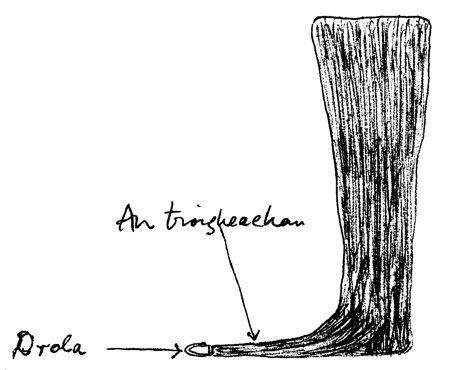
slatan caola seilich ùr no calltuinn mu 3' am fad. Bha thu ’gan dèanamh biorach air an dà cheann, ’gan dathadh ’sa’ mheadhon le dreiseag air an teine, ’gan lùbadh gu cumadh prine-fuilt, ’gan cur eadar rungas cathrach ’gan cumail crom. Bha iad aig an tughdair ag cumail an fhraoich ’na àite. Thogadh e gus an ath bhreth iad mar a bha e ag obair. Rachadh am fagail ’sa’ mhullach. Bha thu ’gan dathadh is ’gan toinneamh an seo [see the arrow in the picture] mus bristeadh iad anns an lùbadh.
Origin: Geàrrloch (Loch Iubh) [Gairloch (Loch Ewe)]
Category: Taigh Gàidhealach / House and Furnishings
-
duileasg
-
[d̪u̟lɤsk] Notes: two kinds, one light-coloured, the other darker, the lighter one being more palatable. Can be eaten alone but used also to be boiled along with meat like cabbage. Called “càl duluisg”.
Location: Harris
Category: Measgaichte / Miscellaneous
-
dòc
-
a hole was made in the ground. Hub placed in the hole and the same process as above followed. Variant on above method [i.e. clach chearcall (q.v.)].
Location: North Uist, Iollaraigh [Illeray]
Category: Measgaichte / Miscellaneous
-
dùdan
-
affected the ears of corn, whereby they went black on the inside although appearing normal in colour on the outside. Also called ‘gaiseadh’ and ‘putharan’.
Location: North Uist, Iollathraigh [Illeray]
Category: Measgaichte / Miscellaneous
-
eacarsaich
-
[ɛxɡəʴsiç] [?] Quotation: ag eacarsaich. Notes: doing some job in a very lively way, energetically. [NOTES: the turned r used for the symbol which is unclear in the original.]
Location: Skye, Breakish
Category: Measgaichte / Miscellaneous
-
eachan
-
a big bi-valve, found under the sand. It has a small teat which protrudes from the shell. It is called ‘ainean’ in Tighnabruaich and ‘aineachan’ in Kintyre.
Origin: Lewis, Uig
Category: Measgaichte / Miscellaneous
-
eaglais
-
This is the word I have always heard for a church but it may be interesting to note that there are three farms in this district called Achnahannet. Not very long ago looking through the dictionary I came on the word ‘annaid’ meaning a church, which may suggest that that word was used in the district at one time.
Origin: Inverness-shire, Nethy Bridge
Category: An Eaglais / Ecclesiastical Terms
-
eilitriom
-
the bier for the dead. It is also called ‘eislig’ by the older people.
Location: Killearnan
Category: Measgaichte / Miscellaneous
-
errair
-
(droch errair) heavy surf on the shore. (Stoer, Assynt) Tha fuiam [sic] mor aig a’ “errair” – when the sound of the swell on the shore was heard at a distance. I understand the word is derived from oir a’ tir – the edge of the land. I never heard it anywhere else except in Durness where it is called “ellair” – “Tha a h-ellair olc.”
Origin: Assynt, Stoer
Category: Biadh is Deoch / Food and Drink
-
eòrna
-
1. Sùgh an eòrna – barley water. 2. Brochan eòrna – barley gruel. ‘Eòrna’ was
always associated with kidney or bladder trouble. Disease: in the list as above [i.e.
infections, retaining water, cystitis, stones in kidney or bladder, discoloured urine]. How
prepared: 1. Simply drinking it after infusion. 2. Mixed into paste with a taste of salt.
Sources of information: locally informed generally.
Location: Harris, Scalpay
Category: Blàthan-Leighis / Medicinal Plants
-
fadhart
-
a serious hurt (old word). Fhuair thu fadhairt [sic] – when a boy falls and hurts his knee etc. ‘seriously’. Perhaps it takes the ‘i’ grammatically: I think so.
Location: Harris, Scalpay
Category: Measgaichte / Miscellaneous
-
faireachdainn
-
Quotation: Tha mi a’ call m’ fhaireachdainn. Notes: I am forgetting myself or I’ve lost track of time.
Location: Achlyness
Category: Measgaichte / Miscellaneous
-
faoileag
-
Quotation: call’ fhaoileag [kɑɫw:lɑɡ]. Notes: flock of seagulls on the surface of the water where there is a shoal of herring.
Location: Skye, Sleat, Calligary
Category: Measgaichte / Miscellaneous
-
feocallan
-
beathach (ferret).
Location: Scalpaigh [Harris, Scalpay]
Category: Measgaichte / Miscellaneous
-
fheusaidh ?
-
see the song Ailein Duinn o hi shiublainn leat in ‘Sinclars’ [sic] [Sinclair’s?] Oranaiche, attributed to Nighean fear Scalpaigh: the song, or a line in the song says Cha b’e call a’ chruidh ’s an fheusaidh? I am wondering is it a corruption? Or should it be Cha b’e call a’ chruidh ’s a’ chéiteinn. I haven’t heard the word being used on Scalpay, and I am wondering… When you’ll get time to look it up, perhaps you may be able to have a definition for it?
Location: Na Hearadh, Scalpaigh [Harris, Scalpay]
Category: Measgaichte / Miscellaneous
-
flagais
-
[fɫɑɡiʃ] Notes: after a heavy haul of cuddies/saithe in October, a trench was dug and alternate layers of cuddies and peat dross were put into it. This was covered with turf divots. Renewed in late spring and put on lea land where corn was to be sown. This trench was called “flagais”.
Location: Coll, Sorrisdale
Category: Measgaichte / Miscellaneous
-
floisean
-
Quotation: Bha floisean aige air. Notes: used, e.g., of a baby enthusiastically sucking a drink.
Location: Applecross
Category: Measgaichte / Miscellaneous
-
foghar
-
Quotation: Foghar Clann a’ Ghobhainn. Notes: name given locally to the spell of good weather in November. So called from local family who were always late with the harvest, and took advantage of this spell of weather.
Location: Tiree, [Caolas? – one slip]
Category: Measgaichte / Miscellaneous
-
fon
-
(far) conj. ‘where’: shin ~ a bheil mi air call; shin ~ andeachaidh a’ mh[...] a dhèanamh; ~ a robh sinn ag obair
Location: Canada, Cape Breton, Inverness Co., Dunvegan
Category: Word List
-
foodlan
-
swivel. (Stoer, Assynt) The “foodlan” is usually an oblong piece of hard wood 4" x 2" x ½" (bigger for cattle) with two holes. The tether threaded through each hole from different side with an overhand knot on each rope, thus revolving in the “foodlan”. The modern iron swivel was merely called “sweevil”.
Origin: Assynt, Stoer
Category: Caoraich / Sheep
-
frachd
-
[frɑxk] Quotation: [hɑ mi dut gɤs ən uɑrɑn ɔrn frɑxk bu:rn] “I’m going to the spring for a load of water.” Notes: a cearcall-load of water, i.e. 2 pails. Still well-remembered in Embo; recognized as an old-fashioned word in Golspie. Source: Mr and Mrs Kenneth MacKay, 16 Gate St., Embo. Date: spring 1968.
Location: Sutherland [see below]
Category: Measgaichte / Miscellaneous
-
fridh-rathad
-
Quotation: “Tha frith-rathad a dol thuige.” – There is a pathway to it. Used metaphorically of those who go astray from the main road. Ghabh e frith-rathad … – He took a devious path … Notes: a bye way.
Origin: West Lewis [the location given on the slips]
Category: Measgaichte / Miscellaneous
-
fuasgladh
-
Notes: diarrhoea. Euphemistically used for buineach.
Origin: Skye
Category: Measgaichte / Miscellaneous
-
fàilligeach
-
Quot.: duine fàilligeach. Note: a man who is physically ailing.
Origin: Uig
Category: Measgaichte / Miscellaneous
-
fàrlas
-
When the fire was in the middle of the floor, a hole was made in the roof directly above it, to let out the peat smoke. This hole was called ‘am fàrlas’. This is the Skye pronunciation and spelling.
Origin: Skye
Category: Taigh Gàidhealach / House and Furnishings
-
gabhail ri
-
Quotation: Chan eil e gabhail rium gu faca mi e. Notes: I am not conscious of (I do not recall) seeing it.
Location: Lewis
Category: Measgaichte / Miscellaneous
-
galair na gainmheach
-
translated as pine by the informant. Caused by eating too much sand and lack of dozing. Also called ‘galair a’ mhachaire’ or ‘galair na h-airde’.
Location: South Uist, Iochdar
Category: Measgaichte / Miscellaneous
-
gille
-
Quotation: gille pliobair [plıbiɾ]. Notes: a person who was at everybody’s beck and call.
Location: Skye, Breakish
Category: Measgaichte / Miscellaneous
-
gille-mirean
-
Quotation: Tha thu na do ghille-mirean aige. Notes: Spinning top. Said of someone who is being used by another, always at his beck and call.
Location: Ross-shire, Aultbea
Category: Measgaichte / Miscellaneous
-
gille-plibire
-
[ɡʹilʹəplıbıðə] Notes: a person who is at everybody’s beck and call and gets nothing in return.
Origin: North Uist
Category: Measgaichte / Miscellaneous
-
gios
-
[ɡʹıs] Quotation: Gios ort! Notes: heard this locally in Portree area for “Greas ort!”
Location: BBC
Category: Measgaichte / Miscellaneous
-
girneilear
-
In some houses, instead of the barrels, a large wooden chest called ‘an girneilear’ held the meal.
Origin: Skye
Category: Taigh Gàidhealach / House and Furnishings
-
glaodhaich
-
Notes: to shout, call.
Origin: Glenlyon
Category: Measgaichte / Miscellaneous
-
glèidh
-
vb ‘win’ : fut.:~idh tu am blàr; fut. rel.: ach ma ghlèidheas mise an cogadh; cond.: bha e ‘ rith m’a chuairt airr a’ chaoraich gus an ~eadh e ‘ chaora a-mach; vbl nn: cò dhiubh ‘
bha e ‘ ~eadh no ‘ call
Location: Canada, Cape Breton, Broadcove
Category: Field Notebooks of Seosamh Watson June-August 1983
-
gobhlachan
-
compass, callipers.
Location: Skye
Category: Measgaichte / Miscellaneous
-
gobhlag
-
The confusion over “gobhlag” seems to have arisen through a wrong spelling. Did I really have “goblag” in the paper? It is in fact the “graip” of every Highland croft. I was surprised to find it included among the implements used locally because farther north it would be considered “sloppy” work to have to resort to this. (‘o’ as in ‘bó’) [NOTES: the paper Mr MacLeod refers to is most probably the peat questionnaire of Sgoil Achadh a’ Chairn (Auchtercairn School).]
Location: Ross-shire, Gairloch, Achtercairn School
Category: Measgaichte / Miscellaneous
-
gocaman
-
cuckoo follower. There is a bird often in partnership flight with the cuckoo bird to which [we] refer on Scalpay as an gocaman. [SLIP: “Cuckoo follower” – a bird which often flies with the cuckoo so called.]
Location: Na Hearadh, Scalpaigh [Harris,Scalpay]
Category: Measgaichte / Miscellaneous
-
goradaireachd
-
Notes: ‘peering’. Source: Callum Matheson, Stornoway. Date: 1977.
Location: [see below]
Category: Measgaichte / Miscellaneous
-
gormaidh (?), gormainn
-
beam. The loom has three beams which are usually called: 1. gormainn aodaich; 2. gormainn shnàth; 3. what is called the ‘rough’ beam.
Origin: [Lewis], Leurbost
Category: Obair na Clòimhe / Wool-Working
-
grioban
-
[ɡðibɔṉ] Note: applied to a person, usually a boy, who is not as developed as he should be physically at his age.
Location: [Lewis], S. Lochs, Gravir
Category: Measgaichte / Miscellaneous
-
gràisg
-
Quotation: gràisg ghille or gràisg ghillean. Notes: rascally fellow, fellows.
Location: Skye, Breakish
Category: Measgaichte / Miscellaneous
-
gròcail
-
warning. “Bodaich a gròcail gun dean sinn call.”
Location: North Uist, Grimsay
Category: Measgaichte / Miscellaneous
-
grògan
-
confused. Chaidh e ’na ghrògan orm – in trying to piece an article or vocally when confusion comes into the matter, the term as noted is expressed, to explain… [SLIP: Confusion, whether in trying to piece an article together, or in speech.]
Location: Na Hearadh, Scalpaigh [Harris, Scalpay]
Category: Measgaichte / Miscellaneous
-
gu siolar
-
in abundance, prolifically. “Bha seagal a’ fàs gu siolar aig an àm sin.”
Location: South Uist, Garrynamonie
Category: Measgaichte / Miscellaneous
-
gug-gùg
-
unfulfilled call, or reference. ’S fhad’ o chuala sinn a gug-gùg sin roimhe’, or that commonplace reference. [NOTES: the slip has ‘gùg-gùg’.]
Location: Na Hearadh, Scalpaigh [Harris,Scalpay]
Category: Measgaichte / Miscellaneous
-
gugalaghù no fiog-falach-fead
-
hide and seek. The player who had to ‘seek’ the others had the following to recite after he had finished counting up to the previously agreed upon number: “Gugalaghù air a chathair / Ma tha duine air mo chùlthaobh / No air mo bheulthaobh, / Sgiob air a shon, tha mise ri ’g eiridh.” Anyone trying to take an unfair advantage by staying too close to the ‘cathair’ was thus automatically counted out.
Origin: Leòdhas [Lewis], Uig
Category: Cur-seachadan: Dèideagan, Geamaichean is Farpaisean / Recreation: Toys, Games, Contests
-
gàdag
-
rope used to support bag of peats being carried on the back. (cf. “gàdag ’s a dhà cheann sgaoilte”, metaphorically of assumptions based on dubious premises. Probably a rope of heather originally and if the two ends were ‘loose’ i.e. free to run, the rope would be unsafe.)
Location: Harris, Tarbert
Category: Mòine / Peat-Working
-
gèineag
-
Notes: (Keose) Game sometimes called ‘Kings’. Two stances. Run from one to other. Person in centre tries to touch others as they run from one stance to other. Called gèinean in Tong.
Location: Lewis
Category: Measgaichte / Miscellaneous
-
gólaisg
-
a showy female, as the miniskirt fashion could recall such as [sic] term, ‘gólaisg’.
Location: Harris, Scalpay
Category: Measgaichte / Miscellaneous
-
hoighlidh
-
[hɤıli] Note: what they called a goal in shinty.
Origin: Uig
Category: Measgaichte / Miscellaneous
-
huisteir
-
Notes: call for a horse: < O.N. hestr.
Origin: Skye
Category: Measgaichte / Miscellaneous
-
huistir
-
[hıʃtʹəɾ] Quot.: Huistir, huistir! Note: call to a horse.
Origin: [Barvas]
Category: Measgaichte / Miscellaneous
-
huistir(e), huistir(e)
-
a call with the purpose of bringing horses back to the caller.
Location: South Uist, South Boisdale
Category: Measgaichte / Miscellaneous
-
ibe
-
pollution, dirt which accumulates at the bottom of the sea and which when disturbed floats up just beneath the sea’s surface. Thereafter occupies a position called ‘eadar dha lionn’, neither sinking nor floating.
Location: North Uist, Iollathraigh [Illeray]
Category: Measgaichte / Miscellaneous
-
inntrig
-
[ĩ:nʹtʹɾiɡʹ] Quot.: “Na thòisich sibh air a mhóine?” “Tha sinn dìreach air inntrigeadh innt.” Note: just started. Heard this used by just one man locally.
Origin: Caversta
Category: Measgaichte / Miscellaneous
-
iodhanach
-
a physically and mentally deformed person.
Origin: ‘Islay connections’
Category: Measgaichte / Miscellaneous
-
iorcall
-
Category: Measgaichte / Miscellaneous
-
keer, keer
-
call to a pet lamb. (Stoer, Assynt)
Origin: Assynt, Stoer
Category: Caoraich / Sheep
-
kirra (?)
-
call addressed to lamb or sheep when inviting it to eat.
Location: [Lewis], Arnol
Category: Caoraich / Sheep
-
langadal
-
seaweed specifically for carrot.
Location: Na Hearadh [Harris], Finsbay
Category: Àiteach / Agriculture
-
laoghachcainn
-
the skin which is taken off a dead calf or lamb and placed on another so as to endear it to its new mother. Also called a ‘luairceinn’. [NOTES: ‘laoghachcainn’ corrected to ‘laoghachcain’ and ‘luairceinn’ to ‘luaircein’.]
Location: South Uist, South Glendale
Category: Measgaichte / Miscellaneous
-
laoghan, laoghan, laoghan
-
call to a calf.
Origin: [Arran]
Category: Crodh / Cattle
-
laomacha
-
this was a slice of the aforementioned cheese [i.e. caise Calluinn] which was said to have special qualities. Supposed to be useful for people who had lost their [sic]. Apparently they could look through a hole in the cheese slice and see where they were. This would apply to people who were lost on hills in misty conditions.
Location: Barra, Ard Mhinish
Category: Measgaichte / Miscellaneous
-
latha buidhe Bealltuinn
-
so called since traditionally, this day was expected to be sunny.
Location: South Uist, Geirinish
Category: Measgaichte / Miscellaneous
-
leirsinn
-
[lẹ:rsinʹ] Quotation: “Bheil thu call do leirsinn?” Notes: sight.
Location: Ross of Mull
Category: Measgaichte / Miscellaneous
-
leòdag
-
[lʹɔ:d̪ɑɡ] Note: hunchback scallop (shellfish – in book).
Origin: Uig
Category: Measgaichte / Miscellaneous
-
liath
-
Quot.: “Theab i mo liathadh.” Note: She nearly gave me grey hairs (metaphorically speaking).
Origin: Kershader
Category: Measgaichte / Miscellaneous
-
lithir
-
[ˈlʹıəð] Quot.: “Tha e air a dhol na lithir.” Note: e.g. said of ground that was harrowed till it had too plain a surface. (Also place in Carloway called Lithir – O.N. derivation.) [NOTES: note added by Richard Cox – p-n is [ˈLʹi-ið̥].]
Origin: Carloway, Doune
Category: Measgaichte / Miscellaneous
-
luairchgean
-
calfskin stuffed. [SLIP: Stuffed calfskin – so called because was stuffed with rushes, straw being too valuable.]
Origin: Kill-Fhinn
Category: Crodh / Cattle
-
luidheir
-
chimney. Sometimes called ‘similear’.
Origin: [Harris? – cf. ‘Taigh Croitear anns na Hearadh – an taigh anns an do rugadh mi.’]
Category: Taigh Gàidhealach / House and Furnishings
-
là
-
Quotation: Là na Taingealachd. Notes: Thanksgiving Day. Not in Dw., though taingealachd is. Source: Lewis usage (D.S.T.). Date: 1972 (recalled).
Location: Lewis
Category: Measgaichte / Miscellaneous
-
mac na sad
-
Notes: used as a term of abuse, either in recall or directly. A’ mhic na sad – of a person who has annoyed one intensely (yet it is fairly mild). Sad ‘dust etc.’ is masc. Source: Lewis usage recalled (D.S.T.). Date: April, 1973.
Location: Lewis
Category: Measgaichte / Miscellaneous
-
maise-mhullaich
-
Notes: ‘baldness’ (an ironic usage). But note the earlier usage, of a luxuriant head of hair, e.g. Ort a dh’fhàs a’ mhaise mhullaiche … Maise gruaige dualach duinne i. (Heb. Folksongs II, 1568-70) Source: Lewis usage recalled (D.S.T.). Date: 1979.
Location: Lewis
Category: Measgaichte / Miscellaneous
-
maodhan
-
a joint called strake point. Two bits of wood like the diagram brought together and fixed by nails.
Location: South Uist, South Lochboisdale
Category: Measgaichte / Miscellaneous
-
maorach Moire
-
similar to scallops.
Location: South Uist, Iochdar, Baile Gharbhaidh [Balgarva]
Category: Measgaichte / Miscellaneous
-
meban
-
distraction, mentally or physically. Rinn e meban dhiom.
Location: Na Hearadh, Scalpaigh [Harris, Scalpay]
Category: Measgaichte / Miscellaneous
-
mial-bhagaid
-
banquet lice. Name given to imaginary lice, as when a youth enters a house, where a newly born baby is announced as receipt, the youth on leaving is approached by someone who will jokingly tease him by calling: Tha mhial-bhangaid ort! (Harris)
Location: Na Hearadh, Scalpaigh [Harris, Scalpay]
Category: Measgaichte / Miscellaneous
-
minidh
-
[mĩṉi] Note: a shoemaker’s awl. “Minidh dearcaidh”: the finer-pointed awl for stitching two parts of the uppers together. “Minidh buinn”: an awl with the tip bent used for soling. Sometimes called “minidh crom”.
Location: Lewis, Uig, Crowlista
Category: Measgaichte / Miscellaneous
-
mitheach
-
Quotation: form of address to a girl: A mitheach/bitheach. A mitheach ort. Notes: bitheach used in Keose, Lochs. Dw. has bithe ‘female, of or belonging to the female sex (Armstrong) (an adj.). Source: Lewis usage recalled (D.S.T.). Date: July, 1973.
Location: Lewis
Category: Measgaichte / Miscellaneous
-
na ruifeanaich
-
Quotation: frayed skin at cuticle-edge on fingers. Source: Lewis usage recalled. Date: noted 14/05/1983.
Location: Lewis
Category: Measgaichte / Miscellaneous
-
na sgrathan
-
These were square pieces of green sod or turf thinly cut with a sharp kind of spade called a ‘caibe-làir’. There was an art in the cutting of a ‘sgrath’ and an ordinary spade would not do. The ‘sgrathan’ were laid on top of the rafters, ‘taobhain’ [q.v.] and ‘maidean-ceangail’ [q.v.] in a very methodical way, so that every inch of wood was covered. Finally the thatch, rushes or heather, was carefully spread on top of ‘sgrathan’ and held down by heather ropes, ‘sioman fraoich’, in criss-cross pattern. To the ends of these ropes, which dangled over the top of wall below, heavy stones called ‘acraichean’ were attached to keep thatch secure in place in time of storm. If the least flaw was detected in a ‘sgrath’ after it was cut, it was at once discarded as unsuitable for the roof of a building.
Origin: Skye
Category: Taigh Gàidhealach / House and Furnishings
-
niodhlag/niùdhlag
-
[ɲj̃ũɫaɡ] [?] Quotation: niodhlagan bhuntàta carrach (from Duan Callainn – Lewis). Notes: a small potato. Not in Dw.
Location: Lewis
Category: Measgaichte / Miscellaneous
-
ochdnar
-
Quotation: “Deanamaid ùrnaigh, is gabhaidh Dòmhnall Aonghuis Bhig òran, is bidh rìdhl’ againn, ’s bidh ochdnar againn.” The Rev. Donald MacCallum, presiding at a concert in Keose. Notes: eightsome reel. Not in Dw.
Location: Lewis
Category: Measgaichte / Miscellaneous
-
pis-eù-is-ù
-
(interjection) for calling a kitten or cat.
Location: Harris, Scalpay
Category: Measgaichte / Miscellaneous
-
platack
-
3. When lines were hauled they were stored in a rush mat called a platack. 4. Platack. Roughly 5' x 4'. When the fisherman got home he untied his platack and red his line into a herring basket or cotton sacks all ready for baiting with either lug worm, limpit [sic] mussel or herring according to time of year. Mainly lug in the summer months.
Category: Iasgach / Fishing
-
plibire
-
Quotation: gille-plibire. Notes: a person who is at everyone’s beck and call and gets nothing in return, a “dogsbody”.
Origin: North Uist
Category: Measgaichte / Miscellaneous
-
pliobair
-
[plibiɾ] Notes: a person who was at everybody’s beck and call.
Location: Skye, Breakish
Category: Measgaichte / Miscellaneous
-
ploc
-
Quotation: am ploc. Notes: liver fluke. Said to be sometimes caused by a plant which grows in water, its leaves spread out on the surface, called [ən̪t̪o:b].
Origin: Bunloit
Category: Measgaichte / Miscellaneous
-
poca-seic
-
Notes: (Callanish) (seic – a semi-rigid bag, made of siaman, used for barley.) Used to describe the riding of children on an adult’s shoulder, one leg on each shoulder and round the adult’s neck. Smith A (Bragar) used for this ‘raoid (i.e. ride) a’ bhreacain uasail’. Dwelly has seic (with a Lewis definition) and poca-saic ‘a large sack thrown across a horse’s back, and large enough to contain a load’.
Location: Lewis
Category: Measgaichte / Miscellaneous
-
poitidh
-
[pɔıtʹi] Note: call to a pig.
Origin: [Lewis], Arnol
Category: Measgaichte / Miscellaneous
-
polasman
-
Note: term [used] locally for beetle found in wells. Dark purple colour when they come to the surface.
Location: Harris, Quidinish
Category: Measgaichte / Miscellaneous
-
preasan (m)
-
Quotation: “Nach ann a sin tha ’m preasan!” Notes: present. E.g. on seeing a dog’s calling card. Usually sarcastic.
Location: Harris, Ardhasaig
Category: Measgaichte / Miscellaneous
-
preeleo no preebheag
-
[call to a cow.]
Origin: [Islay, Ballygrant]
Category: Crodh / Cattle
-
profaid
-
n. ‘profit’: an fheadhain a bha thusa ’ call, sin a’ ph. agad
Location: Canada, Cape Breton, Inverness Co., Dunvegan
Category: Word List
-
pruch
-
call to a cow. (Urq.)
Location: Inverness
Category: Measgaichte / Miscellaneous
-
pruchag!
-
Notes: a call to a pony.
Location: Skye, Strath
Category: Measgaichte / Miscellaneous
-
prug
-
Quotation: prug, prug! Notes: call to a calf. (Also prugan.)
Origin: Harris
Category: Measgaichte / Miscellaneous
-
prugan
-
[pɾu̟ɡɑṉ] Quotation: prugan, prugan! Notes: call to a calf. (Prug also used.)
Origin: Harris
Category: Measgaichte / Miscellaneous
-
pruidh (
-
[pron.] prooee) [prui] call to cow. [NOTES: phonetic transcription added most probably by the fieldworker. The slip has [pruˈi].]
Origin: Kill-Fhinn
Category: Crodh / Cattle
-
pruidh-dhé
-
[call] to a calf. (Urq.)
Location: Inverness
Category: Measgaichte / Miscellaneous
-
pruidh-dhé
-
This was the call for a calf. The ‘ui’ is the same as ‘ui’ in ‘suidhe’ (sitting) and the ‘dhé’ same as ‘dhé’ in the genitive of God.
Origin: Inverness-shire, Nethy Bridge
Category: Crodh / Cattle
-
pruidh-eidh ( prooee-ay)
-
[pron.] call to calf. [NOTES: the slip gives the pronunciation: [pruiˈɛ̜:].]
Origin: Kill-Fhinn
Category: Crodh / Cattle
-
pròisichean
-
another breed [of cattle] so called due to their proud, posturing appearance.
Location: South Uist, Iochdar, Baile Gharbhaidh [Balgarva]
Category: Measgaichte / Miscellaneous
-
raod
-
[rɤ:d̪] Note: a small, physically undeveloped person.
Origin: [Ness]
Category: Measgaichte / Miscellaneous
-
rauladh
-
rolling. (rauladh – colloquially spelt) [SLIP: Rolling (phonetically spelt).]
Location: Na Hearadh, Scalpaigh [Harris, Scalpay]
Category: Measgaichte / Miscellaneous
-
riasaire
-
Quotation: “A-mach á seo thu, a riasaire an diabhail.” Notes: Domhnall Liath, Keose, to Dùghall, brother of Rev. Donald MacCallum, whom he was helping aboard a smack in Loch Erisort. Dùghall had hurt his leg, and had to be slung aboard in a sling. Riasaire < rias, cf. riasach ‘dirty’ (especially about the face). None of these forms in Dw.
Location: Lewis
Category: Measgaichte / Miscellaneous
-
riobag shonais
-
refers to the hair growing on a woman’s chin. Alternately it may be called ‘riobag chonais’ – hair of temperament.
Location: South Uist, Lochcarnan
Category: Measgaichte / Miscellaneous
-
riofanaich (na)
-
Notes: loose ends of skin about base of fingernails (especially common in boys!). Not in Dw. Source: Lewis usage recalled (D.S.T.). Date: 1974.
Location: Lewis
Category: Measgaichte / Miscellaneous
-
roisair
-
a bit of wood used for taking the seed off crops. Process called ‘roiseadh’.
Origin: Uibhist a Tuath [North Uist]
Category: Measgaichte / Miscellaneous
-
rumastaireachd
-
Notes: (a favourite word of my mother’s) rooting about for, searching for something. Not in Dw. (Norse?) Date: recalled 1971.
Location: Lewis
Category: Measgaichte / Miscellaneous
-
rósaidh
-
cattle quite often came under the name ‘rósaidh’. When called upon, they would answer to the name, and make their way home, etc.
Location: Na Hearadh, Scalpaigh [Harris, Scalpay]
Category: Measgaichte / Miscellaneous
-
rùdhadh
-
setting the peats up on end in groups of five or six, with one peat flat over the top of the others, like a ‘crom-lech’ to ward off the rain, a kind of cap. Each group is a ‘rùdhan’. This is called ‘fittin’’ the peats in Kintyre. A lady from Shetland visiting recently used this term fittin’ – probably from ‘footing’.
Location: Cinntire, An Ceann a Deas [Kintyre, Southend by Campbeltown]
Category: Mòine / Peat-Working
-
rùm
-
Quotation: in phrase ‘fo rùm’. Notes: ‘under deck’. (< Norse) Source: Lewis usage recalled (D.S.T.). Date: 1976.
Location: Lewis
Category: Measgaichte / Miscellaneous
-
saogan
-
call to a calf.
Origin: [Skye, Camus Chroise]
Category: Crodh / Cattle
-
scall
-
country servant. Sgalag, N. skall.
Location: Inverness
Category: Measgaichte / Miscellaneous
-
scallag
-
farm hand.
Location: Harris, Borisdale
Category: Measgaichte / Miscellaneous
-
sceamp
-
Quotation: A’ deanamh sceamp – showing off. Notes: < scamp. Retains the sc-, rather than sg-. Not in Dw. Source: Lewis usage (D.S.T.) Date: 1972 (recalled).
Location: Lewis
Category: Measgaichte / Miscellaneous
-
scràbadh
-
Quotation: “Nuair a bha iad a’ scràbadh airson d’athair bha thusa fiachainn seotal na ciste” (to the son of a drowned man). Notes: (Keose) The grappling irons were called scràban (?). Not in Dw.
Location: Lewis
Category: Measgaichte / Miscellaneous
-
sgal-crìche
-
a last resort call, or last report call.
Location: [Harris], Scalpaigh [Scalpay]
Category: Measgaichte / Miscellaneous
-
sgallachan a’ dearrsadh anns a’ ghrein
-
indicative of rainy weather. In this instance the rocks were called ‘sgàthain’ glistening in the sun. [NOTES: ‘dearrsadh’ corrected to ‘deàrrsadh’ and ‘ghrein’ to ‘ghrèin’.]
Location: South Uist, Garrynamonie
Category: Measgaichte / Miscellaneous
-
sgeip
-
Notes: pail-shaped when opened with handles on it. Made of grass or “muran”. Rather like what is called “seic” in Lionel Q.
Location: Lewis, Barvas
Category: Measgaichte / Miscellaneous
-
sgeolldair
-
[sɡʹɤu̜ɫd̪əð] Note: long thin reddish jellyfish which stings. Buckie men called them “scalders”.
Location: [Lewis], S. Lochs, Gravir
Category: Measgaichte / Miscellaneous
-
sgian-fheòir
-
for slicing sections of stacks, esp. cruachan [q.v.]. Done vertically like a saw.
Origin: Tiree
Category: Àiteach / Agriculture
-
sgiorsamaid
-
Notes: Used of something protruding, like a splayed mouth (Keose). Also in a technical sense of the ‘apron’ or protruding lower works of a broch (James – recalling Carloway usage). Not in Dw.
Location: Lewis
Category: Measgaichte / Miscellaneous
-
sgoileapaigeadh
-
(Fuaimnich mar ‘dorchadas’) (Feuch scalloping.) Bideanan, no a leithid sin, air a dheanamh air pàipear, no a leithid sin, air sgeilpe no a leithid sin. Airson sealladh-sùla no a leithid sin.
Origin: [Lewis, Uig an Iar]
Category: Measgaichte / Miscellaneous
-
sgoltadh-gnothaich
-
Quot.: “Chaneil sgoltadh-gnothaich ann.” Note: said of a person who wouldn’t tackle anything enthusiastically and in an effective way.
Origin: [Barvas]
Category: Measgaichte / Miscellaneous
-
sgot
-
Quotation: See quotation sub bliam. Notes: ‘sense’. Not in Dw. Source: Lewis usage recalled (DST). Date: 1976.
Location: Lewis
Category: Measgaichte / Miscellaneous
-
sgrath
-
[sɡrɑ˖h] Notes: brush wood or the word ad foliage of any small tree, usually calltuinn or beithe.
Location: Ross of Mull
Category: Measgaichte / Miscellaneous
-
sgrùthan
-
another name for a small corn rick. More often called a ‘toit’.
Location: South Uist, Milton
Category: Measgaichte / Miscellaneous
-
sgùil
-
Bha an sgùil deanta mar seo: cearcall iaruinn agus lìon, agus am biadhadh air sreing ann am meadhon na sgùile. Bha àrc bìdeag an àirde bho an sgùil air sreang a’ bhiadhaidh airson am biadhadh a dheanamh faicsinneach do an ghiomach. Nuair a bhatar a’ tarruing na sgùilean, bha thu ’g a tarruing cho luath agus a dheanadh do làmhan agus do bhodhaig dhuit. Nuair a bha an giomach am broinn na sgùile, agus a bha i air a gluasad bho’n ghrunnd agus air a’ tarruing troimh an fhairge gu cabhagach, bha an giomach ag greimeachadh ris an nì a bh’aige agus cha charaicheadh e, gu’m beireadh am fear-tarruing air. Nam biodh an sgùil air a tarruing slaodach, bha e toirt cothrom do an ghiomach smaoineachadh de bha tachairt, agus an sgùil fhàgail. Chanadh iad na ‘cearcaill’ ann an àiteachan ris an t-seòrsa uidheam-iasgaich-sa. Tha eachdraidh nam ball-sa gu mionaideach aig Niall M’Dhòmhnaill, fear raoin Chùil-fhodair. Cumadh na sgùile: [see illustration]. An sgùil air a’ ghrunnd: [see illustration].
Origin: [Lewis, Uig an Iar]
Category: Leabhar Deilbh / Drawing Book
-
shoocan no shoocan beag
-
calf call.
Origin: Barra
Category: Crodh / Cattle
-
siadair
-
[ʃıɤd̪ɑɾ] Notes: a useless person, physically, e.g. for fighting.
Location: Skye, Sleat, Calligary
Category: Measgaichte / Miscellaneous
-
siamaich
-
Quot.: “Thug e na siamaich air.” Note: He gave him a lashing (either physically or with the tongue).
Origin: [Barvas]
Category: Measgaichte / Miscellaneous
-
sileagan
-
Notes: ‘jam-jar’. jelly-can (?) Not in Dw. Source: Lewis usage recalled (D.S.T.). Date: Aug. 1975.
Location: Lewis
Category: Measgaichte / Miscellaneous
-
silidh
-
Notes: ‘jam’ < jelly. Not in Dw. Source: Lewis usage recalled (D.S.T.). Date: Aug. 1975.
Location: Lewis
Category: Measgaichte / Miscellaneous
-
siog
-
[ʃiɔɡ] Quotation: [ʃiɔɡ]!, [ʃiɔɡ]! Notes: call to a calf.
Location: Lewis, Barvas
Category: Measgaichte / Miscellaneous
-
siogaire
-
[ʃıɡəðə] Note: a person who looks in poor shape physically.
Origin: Carloway, Doune
Category: Measgaichte / Miscellaneous
-
siogan
-
[ʃiɔɡɑṉ] Note: call to cattle in general.
Origin: [Lewis], Arnol
Category: Measgaichte / Miscellaneous
-
sioman
-
[masc.] the binding rope. The thatch was held down with ‘sioman fraoich’ no ‘sioman murain’ or latterly by coir rope still called in Lewis ‘sioman Thearlaich’ after the merchant who introduced it into the island.
Origin: Eileanaich [natives of Lewis]
Category: Taigh Gàidhealach / House and Furnishings
-
siug
-
[ʃu̟ɡ] Quotation: siug, siug! siugan! Notes: call to a calf.
Location: Canada, Cape Breton, Antigonish
Category: Measgaichte / Miscellaneous
-
siug
-
[ʃu̟ɡ] Note: call to a calf.
Origin: Carloway, Doune
Category: Measgaichte / Miscellaneous
-
siugan
-
[ʃu̟ɡɑ̃ṉ] Quotation: siug, siug! siugan! Notes: call to a calf.
Location: Canada, Cape Breton, Antigonish
Category: Measgaichte / Miscellaneous
-
siugan
-
a call to a calf.
Location: South Uist, Garrynamonie
Category: Measgaichte / Miscellaneous
-
siutal
-
a caller who is also a moucher [sic] [moocher?].
Location: South Uist, Bornish
Category: Measgaichte / Miscellaneous
-
slige-a-chreachainn
-
scallop shell.
Location: Harris, Scalpay
Category: Measgaichte / Miscellaneous
-
slip
-
a slippery sort of a character, who gets away, slips out of trouble, etc. unscathed, gets away with things as termed, locally.
Location: Na Hearadh, Scalpaigh [Harris, Scalpay]
Category: Measgaichte / Miscellaneous
-
slobhcan
-
brown seaweed like substance found on rocks. Boiled and stirred simultaneously for two to three hours. It was then cut up into little bits and strips. Had iron content and supposedly kept the blood clean. Was this called leverbread?
Location: North Uist, Tigharry
Category: Measgaichte / Miscellaneous
-
smeorach
-
[smɛ̱ɔ̣rəx] Notes: sheep marking called a “fork”.
Location: Ross of Mull
Category: Measgaichte / Miscellaneous
-
smior-callich
-
[sic] marrow, very essence of the marrow in the bone. Gu na smior-caillich aige.
Location: Na Hearadh, Scalpaigh [Harris, Scalpay]
Category: Measgaichte / Miscellaneous
-
sneed; cheepick
-
1. Line. Consisted of 10-12 strings, 72 hooks per string. Hooks attached to main line. Every 6ft. By means of a thin, cotton string called a sneed and a horsehair cheepick both approx. 18" long.
Category: Iasgach / Fishing
-
snàthalain
-
a sort of ritual performed when an animal was ill. A woollen rope was made by a woman who was known to have mystical powers. As this rope was constructed, knots were tied in it, with the backdrop of prayers being shouted aloud. These women were known to have been physically sick during this ritual and many were known to have fainted. When completed this knotted rope was attached to the animal’s tail and thereafter the illness would be cured. This was fervently believed in, although you could never be one hundred percent sure it was actually responsible for the replenishment of health.
Location: Eriskay, Taobh na Mara
Category: Measgaichte / Miscellaneous
-
sogho
-
This was the word used for calling a cow. The word is pronounced exactly the same as the fifth note in the music scale but the ‘o’ sound was slightly longer.
Origin: Inverness-shire, Nethy Bridge
Category: Crodh / Cattle
-
spearreach
-
This was a piece of rope tied round ‘iosgaid’, what we called the hough, this was put on a sheep for three or four days to stop it from jumping into corn or going where she should not go. I’ve never seen anything put on cattle. The string or whatever was used could not be left on too long as it would cut into the leg, I’ve often seen that happen.
Origin: Inverness-shire, Nethy Bridge
Category: Crodh / Cattle
-
speilean
-
[spelɑ̃ṉ] Quot.: “a’ cluich speilean”. Note: A game somewhat akin to rounders. A small hollow was made in the ground and a line drawn about 15 yards from it. The apparatus consisted of a ball or cork float (usually the latter), a stick about 9" long (speilean) and a bat like a putter bat (caman) – a flat board about 1 ft long and about 5" wide with a handle attached. Two opposing teams were chosen by two captains. The first side to “bat” was chosen by drawing lots (a’ cur crann). The other team was spread out behind the line, as “fielders”. The “speilean” was put into the hollow at an angle with one end sticking up and the cork float lying on the end in the hollow. The first to bat would shout “Ready?” The other team would say “Tha” and the batter would strike down the protruding end of the “speilean”, causing the cork to be ejected into the air. The batter would then hit it as far as he could. If the cork was caught by a member of the opposing team before it hit the ground, he was out and the next member of the team batted until all were out. If it is not caught the first fielder to reach it gives the batter a “fair” [fɛ:əɾ], throwing it to him so that he can strike it again. If it is caught, he is out. If not, the first fielder to get it rolls it from that spot trying to get it into the hole or as near as possible. This is called “a’ spìocadh” [spi:kəɣ]. If it is holed or comes to rest within a bat’s length of the hole, the batter is out. If it is outside this range, the distance from the hole is measured in bat lengths, the number of lengths being the number of points scored by that player. He carries on until he’s out, then the rest of the team bat in turn until all are out. The other team then bat and all the points totted up, the winner being the side with the highest points.
Location: Harris, Quidinish
Category: Measgaichte / Miscellaneous
-
spidein
-
skimming stones across a stretch of water. Others call this ‘struitairachd’.
Origin: Glasgow/South Uist? or South Uist, Kildonan or South Uist, Garrynamonie or South Uist or Skye, Bernisdale
Category: Measgaichte / Miscellaneous
-
spliongag
-
sling (we call it). Also crann-tabhuill in other places.
Location: Na Hearadh, Scalpaigh [Harris,Scalpay]
Category: Measgaichte / Miscellaneous
-
spoth an tairbh
-
skimming stones across a stretch of water. Others call this ‘struitairachd’.
Origin: Glasgow/South Uist? or South Uist, Kildonan or South Uist, Garrynamonie or South Uist or Skye, Bernisdale
Category: Measgaichte / Miscellaneous
-
spoth-neimh
-
when a stone was thrown straight up, it came down with great force, entering the water without a splash. The sharp report it made was called ‘spoth-’ or ‘sgoth-neimh’.
Origin: Lewis, Uig
Category: Measgaichte / Miscellaneous
-
spriotag
-
Notes: Not in Dw. Splash (of the order of a drop or two). Pl. spriotagan. Vn. spriotagaich, spriotagraich. Source: Lewis usage recalled (D.S.T.). Date: March, 1973.
Location: Lewis
Category: Measgaichte / Miscellaneous
-
spurtadh
-
waulking of tweed (St Kilda); or the word was something as here noted [i.e. spurtu], more nearer I think? One of the women folk throwing a folding across the bench, would recall (spurtu), ‘their colloquial’ [sic]. They had another pronunciation: Do mhangair – it was nothing less than their pronunciation for Do mhathair (Your mother). Cia mar a tha do mhangair, which was their pronunciation of mathair. You may have the word more correctly yourself, as I am only trying to recall it from memory or to memory.
Location: Harris, Scalpay
Category: Measgaichte / Miscellaneous
-
sradadh
-
Quotation: A’ sradadh na bà. Notes: A term used in milking. Not in Dw. Source: Lewis usage recalled (D.S.T.) Date: 1972.
Location: Lewis
Category: Measgaichte / Miscellaneous
-
stail
-
[sṯɤl] Quotation: [sṯɤləspju̟ɾɑdʹʒ] also called [əsṯɤlveɡ]. Notes: spirit still.
Origin: Islay, Port Charlotte
Category: Measgaichte / Miscellaneous
-
stalla
-
a large flat rock. Pronounced as ‘scalla’ in South Uist.
Location: North Uist, Iollaraigh [Illeray]
Category: Measgaichte / Miscellaneous
-
staoig-an-amadain
-
[st̪w:ɡʹən̪ɑməd̪ɑ̃nʹ] Note: cartilaginous piece in the breast of sheep between the ribs. (Some call it “slig’-an-amadain”.)
Location: Harris
Category: Measgaichte / Miscellaneous
-
stealladair
-
Note: applied locally to the cow parsnip as children used to make toy pumps from the stem.
Origin: [Caversta]
Category: Measgaichte / Miscellaneous
-
stiadhag
-
[ʃtʹiɑɑɡ] Note: call to a cat.
Origin: [Lewis], Arnol
Category: Measgaichte / Miscellaneous
-
stike raide
-
“it was customary to assign him a certain share of the spoil, which was called a stike raide or stike creich – ‘road collop’.” (page 252)
Origin: [Lewis, Uig an Iar]
Category: Measgaichte / Miscellaneous
-
stopadh
-
blockage. I have heard of an operation performed on the throat gullet [sic] of a hen by cutting through externally and removing the internal obstruction (with a razor blade) when a foreign body stuck in her gullet, and this operation seemingly being the only alternative medical aid (done locally). The wound of course was sown. If it was a success, if the wound healed, I can’t say. With human beings, if an obstruction of a minor event came forward, say, fish bones stuck in the throat, the cure, or the precautions taken, was to swallow oatcakes, coarse food chewed and swallowed, thus pressing, bringing with it the swallowed bones from their undesirable place, or phase [sic].
Location: Harris, Scalpay
Category: Measgaichte / Miscellaneous
-
streighleag
-
This was little bits of jelly stuff which starts coming away from a cow a week or about ten days before she calves and also the little bits which fall away for two or three days after she calves but not the afterbirth or the cleaning as we call it here, which is the English word we give to it hereabout. ‘ei’ as in ‘feidh’ (genitive of deer).
Origin: Inverness-shire, Nethy Bridge
Category: Crodh / Cattle
-
strianag
-
Notes: Line, stripe. Not in Dw., who has strianagach ‘brindled’. Source: Lewis usage recalled (D.S.T.) Date: March, 1973.
Location: Lewis
Category: Measgaichte / Miscellaneous
-
stìdeag
-
Notes: The name of Crawford’s cat, which he usually had in school with him. Crawford was the Keose (Cnoc Ian Duibh?) schoolmaster in the time of Rev. Reid – married Reid’s niece. He came from about Forres, and was a Gaelic speaker. Dwelly has stidean ‘cat; call for a cat (Badenoch)’.
Location: Lewis
Category: Measgaichte / Miscellaneous
-
sugan
-
jug; was also used as an interj. in calling a milking cow for to arouse the cow’s interest for to give her milk at milking time, perhaps.
Location: Harris, Scalpay
Category: Measgaichte / Miscellaneous
-
sugan beag
-
ri loagh [sic] [call to a calf].
Origin: [Islay, Ballygrant]
Category: Crodh / Cattle
-
suidse
-
Quotation: Ma bha iad leisg gu tòiseachadh chuir Dòmhnall suidse riutha. Notes: ‘haste, impetus’. Not in Dw. From Eng. ‘switch’ (?). Source: Lewis colloquial usage recalled (D.S.T.) Date: 27/12/1971.
Location: Lewis
Category: Measgaichte / Miscellaneous
-
suil
-
The Raven’s call: Suil caora, suil caora / Càite, càite / ’Sa làthaich ’sa làthaich
Origin: Barra
Category: Caoraich / Sheep
-
sulaire
-
gannet. Also called ‘eun bàn a’ sgadain’.
Origin: Glasgow/South Uist? or South Uist, Kildonan or South Uist, Garrynamonie or South Uist or Skye, Bernisdale
Category: Measgaichte / Miscellaneous
-
susamailt
-
Quotation: B’e am facal “susamailt” – sùgh nam measan air a bhruich le siùcar, mar a their sinn ’sa Bheurla, jelly. Notes: Mrs. MacFarlane heard the above word from her father, Mr. John MacCallum of Taynuilt. Source: letter from Mrs. Mary MacFarlane, Taynuilt. Date: 20/11/1966.
Location: [see below]
Category: Measgaichte / Miscellaneous
-
sàs
-
Quotation: (1) Bha iad a sàs na chèile. (2) Bha e a’ sàs ann. Notes: (1) either verbally or physically. (2) He was getting on to him.
Location: Lewis, Barvas
Category: Measgaichte / Miscellaneous
-
ta
-
prefix “continual”; ta-ghairm – ever-calling; ta-mhaoidheamh – ever-threatening; ta-ghul – ever-weeping.
Origin: [Strathglass]
Category: Measgaichte / Miscellaneous
-
taigh a’ bhainne
-
The milk house. A small bothy built of drystone and thatched. It had no window and this kept the milk and cream delightfully cold in hot summer weather. ‘Tigh a’ bhainne’ had a press or cupboard where milk vessels were kept. Here the housewife kept her ‘crannachan’ or churn, a tall round wooden vessel with its perforated lid, or ‘lumachan’, through which the long handle of the ‘loinid’ (churn-staff) entered. Here, too, she kept her ‘crog’ of butter with its immaculately white skin covering called ‘imideal’, and ‘fiodhan’ [q.v.], a wooden receptacle, where cheese was made.
Origin: Skye
Category: Taigh Gàidhealach / House and Furnishings
-
tallan
-
The partition between rooms, built of stone as a rule, and sometimes of wood, especially the wall which separated the living room from the sleeping quarters. In early times it was made of interwoven twigs. Also called ‘balla-tarrsuinn’.
Origin: Skye
Category: Taigh Gàidhealach / House and Furnishings
-
tallan agus callabho
-
partition. [NOTES: ‘callabho’ corrected to ‘calabhò’.]
Location: South Uist, Daliburgh
Category: Measgaichte / Miscellaneous
-
tamhasg
-
stupid, a person making a mistake and another person remarking as here: tamhasg. [SLIP: What a person making a silly mistake is called – i.e. stupid.]
Location: Na Hearadh, Scalpaigh [Harris,Scalpay]
Category: Measgaichte / Miscellaneous
-
tannt
-
[t̪ɑ̃n̪t̪] Notes: a miscalling (from taunt).
Location: South Uist, Bornish
Category: Measgaichte / Miscellaneous
-
taomadh
-
Notes: (Murdo Murray, Back) in sense of shovelling the earth at the sides of the feannagan and in the claisean, on top of the feannagan. Murdo Murray recalls an old woman telling him how she got 1/-6d a day for peat-cutting, but only 1/- a day for taomadh. Dwelly has this sense, without as much detail as above.
Location: Lewis
Category: Measgaichte / Miscellaneous
-
taorais
-
stop call to a cow.
Origin: [Skye, Camus Chroise]
Category: Crodh / Cattle
-
tasdan
-
Notes: 20 cent coin called this. [NOTES: slipped under ‘tastan’.]
Location: Canada, Christmas Island
Category: Measgaichte / Miscellaneous
-
theap or theip
-
almost. I spelt the former in this form I think (h-ip) demonstrating a little difference in pronunciation, which in this case matters little, for to note, and could perhaps be dismissed as the first is not grammatically spelt I think.
Location: Na Hearadh, Scalpaigh [Harris, Scalpay]
Category: Measgaichte / Miscellaneous
-
tiorramachd
-
deficiency in cattle which resulted in them drying up. Would deteriorate physically leading to a reduction in size. Castor oil was used as a cure.
Location: South Uist, Stoneybridge
Category: Measgaichte / Miscellaneous
-
tiug, tiug
-
[tʹʃu̜k, tʹʃu̜k] Notes: call to hens.
Origin: Islay, Ballygrant
Category: Measgaichte / Miscellaneous
-
togail chreachan
-
Le sgumair. Small spoon net. Slat no maide fada, is cearcall iaruinn le lion ’na phoca ceangailte ri bàrr na slaite.
Location: Lewis, Port of Ness, Lionel
Category: Maorach / Shellfish
-
torchan!
-
interjection (call-name) for a bull. [SLIP: Used when calling for a bull.]
Location: Na Hearadh, Scalpaigh [Harris, Scalpay]
Category: Measgaichte / Miscellaneous
-
treun
-
Quotation: Nuair a bha e ’na threun. Notes: When he was in his prime, at his peak physically.
Location: Skye, Sleat, Calligary
Category: Measgaichte / Miscellaneous
-
treòramach
-
not physically effected [sic] [affected?] to a big extent; are you very able to go about; considering, as a welcome salute to an aged person. From the term ‘treòirimeachd’.
Location: Na Hearadh, Scalpaigh [Harris, Scalpay]
Category: Measgaichte / Miscellaneous
-
trobhad “merag”
-
calling a cow. (Stoer, Assynt)
Origin: Assynt, Stoer
Category: Crodh / Cattle
-
trobhad, trobhad, trobhad
-
call to a cow.
Origin: [Arran]
Category: Crodh / Cattle
-
tuagal
-
goal. Subsequently called “hail” when shinty was played to modern shinty rules. (Stoer, Assynt) Shinty was always played on New Year’s Day, “Latha na Callain”. Two townships would compete, and after the match was finished the visiting team would try and dribble the “creg” out of the township. I saw old boddich of 70 running out with walking sticks to prevent the “creg” being taken out of the township, which was considered a great disgrace! So long as the numbers were equal there appeared to be no limit to the number on each side for the actual match. I played for Caberfeidh Shinty Team, but it was child’s play in comparison to those New Year’s Games! At half time – the match was usually two hours – whisky was distributed – not lemons! Incidentally, if a visiting township managed to get the creg away, they had the privilege of having the match in their township next New Year.
Origin: Assynt, Stoer
Category: Cur-seachadan: Dèideagan, Geamaichean is Farpaisean / Recreation: Toys, Games, Contests
-
tàbh
-
air son glacadh chudaigean agus shùithean, an t-iasgair a’ tilgidh maoraich no biathadh eile ’san mhuir air son an t-iasg a tharruing, agus ansin, cuiridh e an tàbh do’n uisge fo’n èisg agus sguabaidh e gu tìr iad. Cearcall iaruinn no fiodha agus lion air a cheangal ris. Làmh fhada fhiodha ceangailte ris a chearcall.
Origin: An t-Eilean Sgitheanach [Skye; Skye, Glendale acc. to other questionnaires]
Category: Acfhuinn Iasgaich / Fishing Tackle
-
tàbh (E agus I)
-
Mur a lorg mi as t-samhradh, chan eil ainmeannan agam airson an tàibh ach ‘cas an tàibh’ agus ‘cearcall an tàibh’. Bhiodh aon cheithir aitheamh anns a’ chearcull, aig beul an tàibh. Ach bhiodh feadhainn na bu lugha na bhiodh againne aca ann an àiteachan eile. Cha chreid mi nach biodh tàbh againn E agus I mar a fhreagradh.
Origin: Leòdhas [Lewis], Uig an Iar
Category: Acfhuinn Iasgaich / Fishing Tackle
-
tàbh (sometimes scummar)
-
a large type of landing net. Parts: bogha màis, cas, cearcall, slatan, lion.
Origin: Barra
Category: Acfhuinn Iasgaich / Fishing Tackle
-
tàthag
-
(Faic tàtag.) ’Se seo a bh’aig Calum MacLeòid do Dwelly (t-d 937). ’Se ‘tàthag’ a chuala mise a riamh ’s a bhaile. Baile Chaluim ’ic Leòid, cuideachd. ’Se buaidh bho’n taobh muigh, no bho sgrìobhadh, a bhiodh aig Calum. “Also used metaphorically as thug e t. dha, he gave him a stab (in speech).” (Dwelly t.d. 937)
Origin: [Lewis, Uig an Iar]
Category: Measgaichte / Miscellaneous
-
tèamain
-
attractive, stiff cloth made from the longest and best type of wool. Women’s dresses and men’s coats and capes made from this material. Sent to the mainland to be finished or dressed. Then called ‘caimleid’. [NOTES: note added in pencil: fuaim?]
Location: South Uist, Garrynamonie
Category: Measgaichte / Miscellaneous
-
tùchair
-
a lid on a pot. Also called ‘sgiob’.
Location: North Uist, [Carinish], Cnoc Cuidhein [Knockquien]
Category: Measgaichte / Miscellaneous
-
àite suidhe
-
seat at the back of a boat. Elsewhere called ‘sileadh’.
Location: North Uist, Grimsay, Ceannaraigh
Category: Measgaichte / Miscellaneous
-
àth
-
Quotation: “Bath m’ath’s bhathainn’s i nam bu t-ath’s i.” Notes: supposed to be a test of strangers: if he thought you were talking double-Dutch, he evidently had no Gaelic. It was meant to be said as one long word, which a man used to call for help from his neighbour when his KILN was on fire.
Origin: West Lewis [the location given on the slips]
Category: Measgaichte / Miscellaneous
-
èigh
-
vb ‘call': past: dh'~ [je:v] ad an duine seo
Location: Canada, Cape Breton, Broadcove
Category: Field Notebooks of Seosamh Watson June-August 1983
-
éigheach-tathaisg
-
Notes: shout heard be people outside before a person died. A fairy called Caoineag in charge of it. Her laments heard in vicinity where death imminent. Last heard in Skye about 1910 in vicinity of Portree. Wailing heard in the immediate vicinity of Portree. Matter brought to attention of Rev. Norman MacLeod, most learned [?] of his day. Said that holocaust would follow. Fulfilled in 1914 War.
Origin: Skye
Category: Measgaichte / Miscellaneous
-
òrd cliurair
-
used for chipping grinding stones in the mill. Process called ‘breacadh nan clachan bràthaidh’. [NOTES: ‘cliurair’ corrected to ‘cliùrair’.]
Location: South Uist, South Boisdale
Category: Measgaichte / Miscellaneous
-
‘ciorrag bheag’
-
[call to a lamb or sheep] or sometimes imitating the bleat, e.g. ‘maa bheag’.
Origin: Lewis, Uig
Category: Caoraich / Sheep
-
‘pis-thu-isu’
-
calling a kitten. [SLIP: Used when calling a kitten.]
Location: Na Hearadh, Scalpaigh [Harris, Scalpay]
Category: Measgaichte / Miscellaneous
-
“trobhad, piatan, piatan, piatan beag”
-
call to a calf.
Origin: Leodhas [Lewis], Uig
Category: Crodh / Cattle
-
“trobhad, siugan, siugan, siugan beag”
-
call to a cow.
Origin: Leodhas [Lewis], Uig
Category: Crodh / Cattle